

A Global Weighing Machine
When The Votes Drown Out The Scale


This is a free weekly newsletter about the art and science of building and investing in tech companies. To receive Investing 101 in your inbox each week, subscribe here:
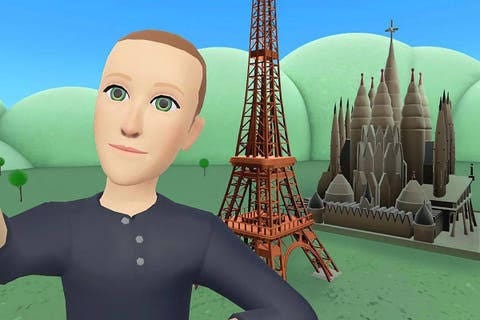
Over the course of 2021, we experienced something akin to a mass psychosis. The global currency would be denominated in monkey JPEGs and the future would be lived through eery Zuckerberg-grinning avatars.
Then, in 2022, we woke up. If ever so briefly. And something funny happened. A company that sells, in the words of Weird Al, “allen wrenches, gerbil feeders, toilet seats, [and] electric heaters” was worth more than Facebook. Not “worth more per employee” or some cherry-picked metric. Straight up the lumber shop was worth more than your Mom’s favorite source of ragebait. I’m talking, of course, about Home Depot.
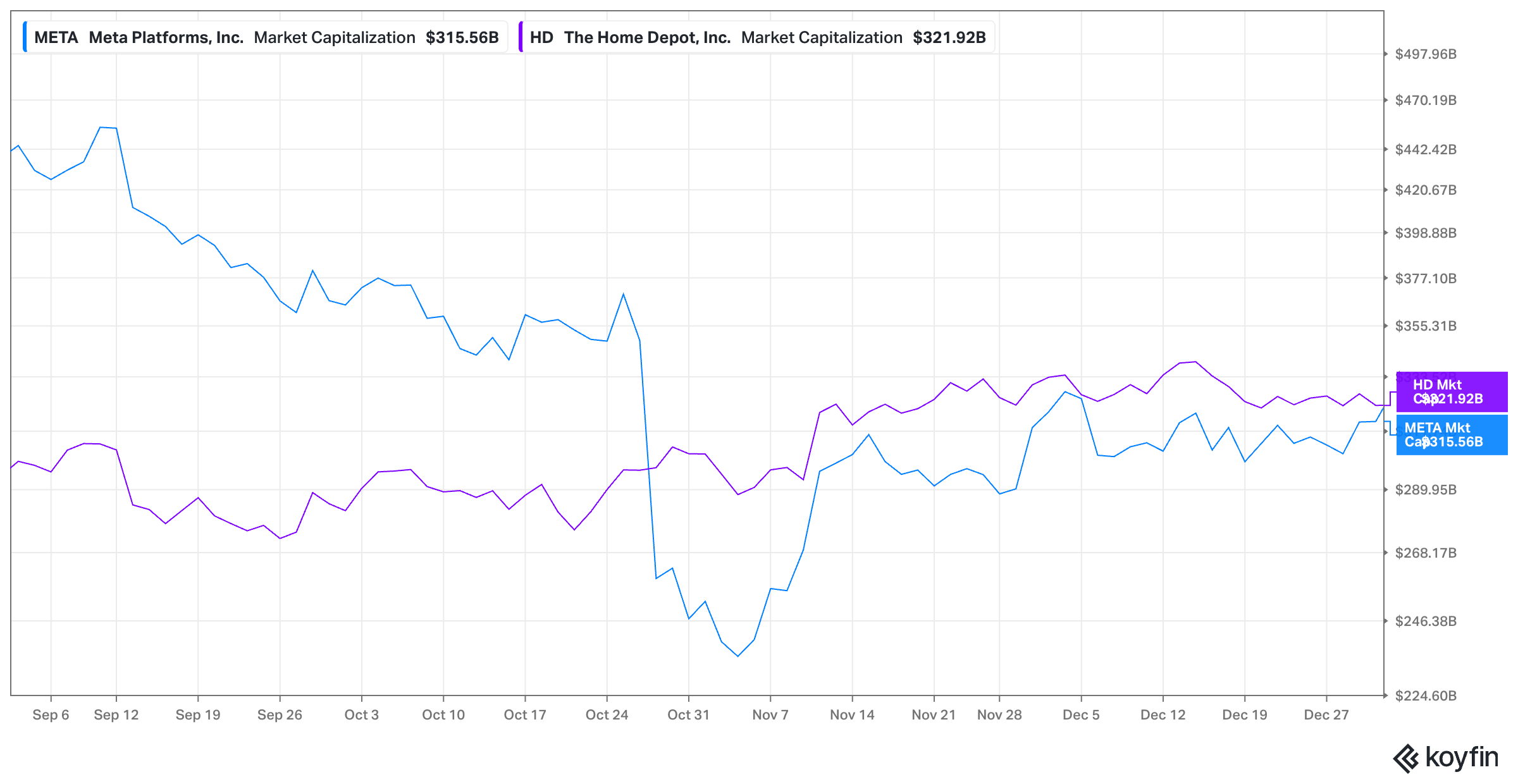
In late October 2022, Meta’s vision of the Metaversal Future was landing with investors about as well as a poop-filled paper bag on your local nerd’s doorstep. The company slid clean out of the 20 most valuable companies in America. Something like $600B of market cap (70% of its value) disappeared. Just a year earlier, it had briefly hit a trillion dollars! In the wreckage, Home Depot’s market cap surpassed Meta’s. An orange-aproned hardware store was worth more than the company that had spent a decade representing the future.
Looking at that chart of Home Depot’s slow and steady rise amidst Meta’s intense volatility, I couldn’t help but think of a famous Charlie Mungerism: “take a simple idea and take it seriously.”
Don’t get me wrong. This isn’t to say “tech is dead” or “lumber is the future.” Since then, Meta has rocketed back while Home Depot has continued its slow and steady ride.
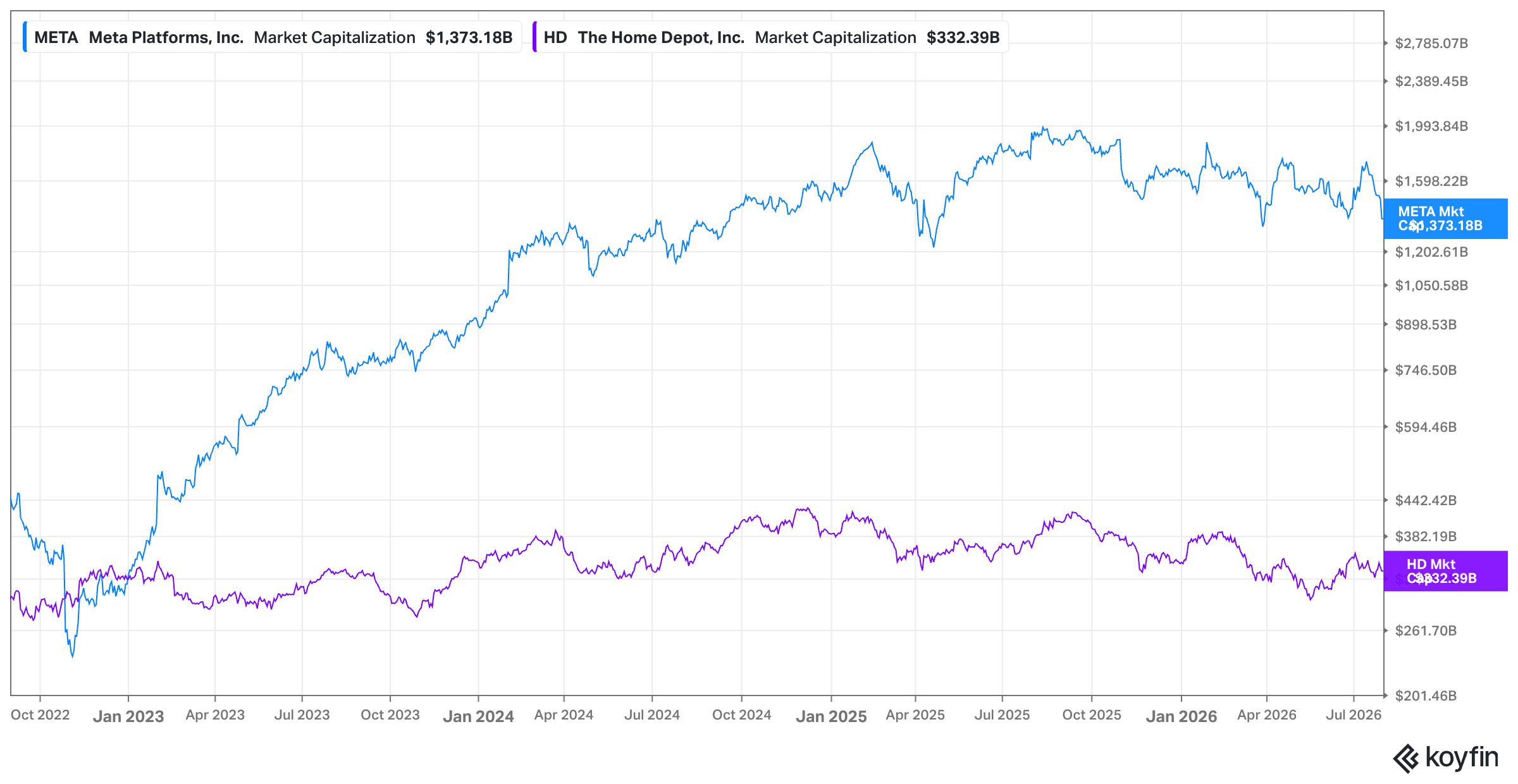
Instead, this was an instructive moment in time. A whole investing lesson compressed into a few months. The point was never that a hardware store would perpetually outperform a tech giant. It was that, for a clean, revealing moment, the “voting machine” in the market drained of the exciting narrative and shed light on the boring one that performed best in the “weighing machine.” That’s one of the simplest ideas in finance that may, increasingly, not be true.
The Simplest Idea In Finance
This might be something you’ve heard a dozen times before. Most people attribute it to Ben Graham. At best, its a paraphrase of Warren Buffett that you won’t find in Security Analysis or The Intelligent Investor. It’s the line that every value investor has tattooed on their forehead:
“In the short-run, the stock market is a voting machine. Yet, in the long-run, it is a weighing machine.”
In the short run, price is a popularity contest. It’s votes. It reflects what the loudest people with the most capital have decided they want to believe in any particular quarter. But stretch the horizon out far enough and the votes stop mattering; they were always noise. Eventually, the signal shines through on the scale. That scale weighs what the business actually produces and it doesn’t particularly care what people think of it. One of the best framings comes from Buffett’s Berkshire letters: “time is the friend of the wonderful business, the enemy of the mediocre.”
I’ve written about this idea before: don’t just vote with your money, invest in platforms that can be weighed, measured, and found to be everlasting organizations. Elsewhere, I argued that the same weighing machine runs everything, not just stocks. “The Market” is like an ethereal force that prices everything from meme stocks to annuities or whether you eat the whole bowl of peanuts before dinner. “Price is what you pay, but value is what you get.” The weighing machine is the ultimate arbiter. Or at least... it was.
Because baked into the idea of short-term voting and long-term weighing is one comforting assumption: that the weighing machine always, eventually, wins. That the votes are noise and the weight is signal. You can be wrong for a while, embarrassingly, expensively wrong, but if you bought something genuinely heavy, the scale will eventually swing your way, allowing you to taste sweet, sweet vindication.
But, increasingly, we don’t live in a Market Economy. We live in a Meme Economy. And that evolution may have made the Global Weighing Machine relatively impotent.
The Meme Heard Round The World
I’ve written before about the Meme Economy, and no anecdote better illustrates it better than the Dark Week of SVB’s Collapse.
On Wednesday, March 8th, 2023, SVB sent out a shareholder letter. The gist: “hey, no big deal, we took a $1.8B loss selling some assets, and, totally unrelated, very chill, we also need to raise $2.3B of capital in the next few days. Zero stress. Be cool.” It is, to this day, one of the worst pieces of corporate storytelling I have ever seen. Like a Gen Z hostage note that couldn’t give fewer f*cks.
Surprisingly, that vibe didn’t resonate with customers. 🤷 And in a world that runs on stories, a story left unbelieved metastasizes like a cancer. The next day, March 9th, depositors tried to pull $42B out in ~8 hours. That was ~25% of the banks entire deposit base, gone in an afternoon. The next morning, another $100B was lining up to walk out the door. All in, customers tried to yank $142B over the course of two days; 81% of the bank’s balance sheet. The weighing machine never got a say because everyone was too busy voting, and voting fast.
The craziest part of this story, which wasn’t lost on anyone who lived through it, was that SVB wasn’t strictly killed by its balance sheet. It’d made some bad bets, sure. But what bank hasn’t? Banks limp along on bad math all the time. What killed SVB was the story moving at the speed of a group chat. People called it the first social-media-induced bank run. Brad Klontz, at CNBC, described it this way:
“A social contagion happens. It comes down to our herd mentality, our tribal brain… It’s like a mass delusion that becomes a reality. We create our own crises.“
A mass delusion that becomes a reality. Evan Armstrong zeroed in on the speed as the truly extraordinary feat:
“To me, the most remarkable part of this whole experience has been the speed at which it happened. It went from a small group of insiders sending emails to their portfolio companies to $45B in outflows in less than a day… We are looking at secrets being used at the speed of the internet.“
Bank runs are nothing new; you can trace them back to the 1600s. But the largest run before SVB had ~40% of SVBs volume and played out over the course of ten days, not one. Granted, the internet didn’t invent the Meme Economy (see: Tulip Mania). But it did lay out a line of cocaine and strap rockets to its back. And now that votes are being constantly cast at the speed of light across microcosms of microcultures, “the long run” stops being a certainty of the patient and becomes a luxury you may not be able to afford. “The market can stay irrational longer than you can stay solvent.”
Reality Is a Story
There’s this idea from Yuval Harari that I come back to repeatedly, not because I fully agree with it, but because it articulates something important:
“There are no gods in the universe, no nations, no money, no human rights, no laws, and no justice outside the common imagination of human beings. Whether or not something is true doesn’t impact whether you believe it.”
Money is a story we all choose to believe. A corporation is a story. A dollar is worth more than the paper it’s printed on because we all got together and agreed to keep telling that story. A bank is a solvent story until enough people, quickly enough, decide to tell a different story. Saying reality is a story isn’t just cute post-modernism wearing a very fine beret. At sufficient scale, the votes can change the weight. The belief doesn’t just mis-price the asset for a while, it reaches in and edits the asset!
I’ve argued before that we’re not falling away from some golden age of respect for facts; we’re defaulting back to a quintessentially human drive to believe in stories. When a story goes from a niche to a norm, it’s because everyone started paying attention. There’s a sort of folk name for that in tech: a reality distortion field.
Walter Isaacson used it to describe Steve Jobs, and his ability “to convince himself, and others around him, to believe almost anything,” an “eagerness to bend any fact to fit the purpose at hand.” Visakan Veerasamy calls the deeper version of it “deviance”:
“Once you have succeeded at some kind of deviant shit (e.g. distorting reality) your ontology is permanently corrupted… think about what it feels like to have everyone in your life tell you that something can’t be done, and then you do it.“
We romanticize the idea because when a founder bends reality, and it works, we call it vision. Mike Moritz once quipped about Elon Musk that he’s great at telling stories, and they sometimes even come true. But the same mechanism that lets Elon talk a rocket into existence is the same mechanism that lets a group chat talk a bank out of existence.
Hype as a Fundamental
Meme Economy. Reality Distortion Fields. Deviance. There’s an even fancier, older version of this made famous by the ol’ Hungarian activist investor himself, George Soros. He built an entire empire on the theory of reflexivity. The classical idea is that prices are a mirror because they reflect fundamentals. Soros’ claim took it further, saying the mirror is warped and that the warped reflection can reach back out and change the thing it’s reflecting. He describes it as two functions: a cognitive function (where the world shapes your mind) and a manipulative function (where your mind shapes the world).
“The participants’ views influence but do not determine the course of events, and the course of events influences but do not determine the participants’ views… Once time is introduced, reflexivity creates indeterminacy and uncertainty rather than paradox.“
That hearkens back to the CNBC fella talking about SVB: “a mass delusion that becomes a reality.” A high price draws in believers, the believers’ capital changes the company’s prospects, the changed prospects justify the price, the justified price draws in more believers. Rinse, repeat, add an Elon Musk-character and send that shiz to the moon, diamond hands style. At scale, hype becomes a fundamental.
I’ve written before about how hype is like a physical force that belongs on the periodic table. Its social and economic impacts are as real as oxygen or hydrogen. “As powerful as gravity, but as made up as capitalism.” The votes are made up, but also, at sufficient scale, become like a steel foundation.
This brings me to the best articulation of hype / reality distortion / memes / mass delusions as not just a physical force, but a critical piece of the puzzle: Byrne Hobart’s book, Boom: Bubbles & The End of Stagnation. Reality-bending delusions are, often, the underrated drivers of progress because optimism can become a self-fulfilling prophecy. And a bubble is “not simply a collective delusion but an expression of a future that is radically different from now.” Speculation is how civilization funds its most exploratory bets before the spreadsheet can justify them. Sometimes the crowd “votes” the future into existence. But it requires a lot.
Simple Isn’t Easy
The idea of reflexivity and votes becoming real sort of makes the average value investor’s belief in the “Great Weigh-In” look less like wisdom and more like a mental disorder. That brings me back to Munger’s line. He doesn’t just say take a simple idea. He says take it seriously.
You might assume “simple” means “easy”. But there’s a great line from Poor Charlie’s Almanack from Frederick Maitland: “Simplicity is the end result of long, hard work, not the starting point.” The editors of that book describe Munger’s clarity as something that “comes only at the end of a long journey toward understanding, not at the beginning.” The simple idea is the destination. Munger also liked to quote Huxley on what an education is actually for: “the ability to make yourself do the thing you have to do, when it ought to be done, whether you like it or not.” Taking an idea seriously is a big part of the boring thing.
Another solid Mungerism comes from Jesse Livermore where he says the big money is in the waiting, not the buying and selling. Those cigar-butt fellas liked to talk about Ted Williams, a baseball player, focusing on his sweet spot, never swinging unless a pitch looked just the way he liked it. Buffett and Munger used to say they wouldn’t care if the market closed for a couple years. They were just doing a whole lot of waiting.
But a seemingly contradictory nuance about “doing nothing” isn’t necessarily passivity. Munger, yet again, had a quote for that too. “Anytime you sit there waiting for a deal to come by, you’re in a very dangerous seat.” Seriousness is less about passivity and more about active, almost exhausting patience. The willingness to do a ton of work and then not act until the work tells you to act. As Munger puts it, describing his and Buffett’s actual edge, “it is remarkable how much long-term advantage people like us have gotten by trying to be consistently not stupid, instead of trying to be very intelligent.” Consistently not stupid. Such a great line.
Home Depot’s Weight
So how does a hardware store win the weigh-in?
Because Home Depot is a machine. People will always need lightbulbs and allen wrenches. That might be dull, but it isn’t going anywhere. The company throws off cash, buys back its stock, pays dividends, etc.
Don’t get me wrong, Facebook in 2021 was a great business too. I don’t mean to dunk on Meta... at least... not all of it. But what was under the hood with Home Depot in October 2022 was a durable, unglamorous, cash-printing engine. What was underneath Meta’s stock price, in that particular moment, was a story that the voting machine had briefly stopped believing. “Metaverse who? No thank you.” When the rose-colored glasses of the popularity contest briefly wore off, the weighing machine shone through.
It’s just that the physical force of hype is getting better and better at keeping the weighing machine away. Buffett’s whole world view was completely dependent on the weighing machine. He talks about testing moats by determining whether they become “stronger and more durable.” Business history, he warns, is full of “Roman Candles,” companies whose moats turned out to be illusory, and “a moat that must be continuously rebuilt will eventually be no moat at all.” The weighing machine is supposed to constantly check whether that durability needs to be rebuilt or not.
Buffett’s weighing machine assures you that you may not get rick quick, but that you can get rich slowly. But what happens if the dummies hooked up to the voting machine just keep getting rich over and over again, never giving any breathing room to the weighing machine?
Does Gravity Still Exist?
In moments of volatility, it’s important to step back and acknowledge that the “weighing machine” still exists. Gravity still plays its part. Hopin went from a $2B valuation to $7.7B in nine months on the back of a COVID story, and when the story expired, the company’s usefulness collapsed from 15K events a month to 158, and the flagship product sold for a ~95% haircut off that high. WeWork raised $22B at a $47B peak and later carried a market cap you could round to zero. Peloton went from a $45B peak to $3.4B; Bird from $2.5B to $22M. In the public wreckage of 2022 you could read the same machine at work (e.g. Robinhood down 79% from its high, Peloton down 81%, etc.) the scale quietly re-weighing every high-flier the votes had carried. Who knows, maybe what we’re seeing with Situational Awareness this week is the beginning of the latest whomp of gravity’s fist.
My favorite piece I think I’ve ever written, Institutionalized Belief In The Greater Fool, is like a hymn to the forces of gravity.
But.
Gravity winning eventually is cold comfort if hype outruns it within your holding period. The scale is undefeated over infinite time, I do believe that. But you, unfortunately, do NOT invest over infinite time. Most investors have an activity window. And inside that window, “popular” and “right” can diverge for so long that, for your actual purposes, popular is right, and refusing to underwrite the popularity is just trying to look chill while losing a shiz ton of money. Worse than that, the crowd doesn’t politely capitulate when the facts arrive. “A man with conviction is a hard man to change.” Regardless of “truth.”
There’s a story told by Keynes in 1936 where he compared professional investing to a newspaper contest where you pick the six prettiest faces out of a hundred photos, and the prize goes not to whoever picks the objectively prettiest, but to whoever’s picks match the average pick of everyone else playing:
“It is not a case of choosing those which, to the best of one’s judgment, are really the prettiest, nor even those which average opinion genuinely thinks the prettiest. We have reached the third degree where we devote our intelligences to anticipating what average opinion expects the average opinion to be.“
I’ve written about this before: you’re not really trying to determine what a stock price will do, you’re trying to determine what you think other people think a stock price will do. Classic Girardian memetic theory; “we want not what we desire on our own but what we think other people desire.” Where Graham and Buffett are saying “weigh what’s there,” Keynes and Girard are saying “read the crowd.”
The weighing machine is real. But the voting machine is also real. And getting realer. More real. Really-ey-er? Whether you like it or not.
I used to think hype was the enemy and that the disciplined would, ultimately, move against the loudest thing. But the reality is that consensus is dangerous, whether it’s consensus optimism or consensus pessimism. The voting machine can land with a thumb pointed up or down. Instead, the real trick is to believe that the weighing machine can evolve and take into consideration the voting machine.
In a piece called “Build What’s Fundable”, I argued that the real danger of consensus-forming, or even consensus-manufacturing, is that it becomes harder and harder to actually weigh the worth of anything. So what do you do? Do you throw in the towel and YOLO into the AI slop trade? I wouldn’t say so.
Instead, you acknowledge some fundamental truths, most of which I’ve written about before. First, storytelling is a core skill, not a soft skill. Take is seriously. Second, the crowd is inside the price. Packy McCormick described it by saying “business is the new sports.” The audience is on the field and the fans can change the score, so you can’t ignore them. Finally, the only stupid game is failing to recognize that there are different games. You can wait out the weight, you can ride the the wave counting votes
The weighing machine isn’t broken. It’s just been forced to internalize the reality of a Meme Economy that used to be a short term annoyance, but is not a long-term reality.
Thanks for reading! To receive Networked Conviction: My Investing Journal, a collection of portfolio updates, Requests for Startups, and investing ideas for paid subscribers, you can sign up below:
Thanks, Kyle, for another great piece. I've been thinking a lot about the role of narratives in investing lately. It feels like more people are becoming traders than investors, driven by noise, narratives, and others' opinions rather than independent thinking. At times, it even makes me question my own contrarian approach. Still, I believe the worst investments are those built almost entirely on self-reinforcing narratives instead of durable fundamentals.