

An American Redemption
My Annual Love Letter To America


This is a free weekly newsletter about the art and science of building and investing in tech companies. To receive Investing 101 in your inbox each week, subscribe here:
Starting in 2024, I reflected gratefully on the US of A around the Fourth of July. As a result, I sat down to pen a “love letter to America.” The next year, I found myself revisiting the same theme at the same time, writing about that “ongoing love affair.” Apparently this is a tradition now, which is just a habit you’ve decided to be proud of. So I’m sticking with it.
Speaking in generalities is always dangerous, but despite the need to account for nuance, I can’t help but feel like I’m in a vocal minority within my generation; those willing to kick against the pricks, and position ourselves against the general melancholy most people my age feel about the US.
Regularly, I come across yet another American issue, whether historical context to reckon with, or active decisions being made today that fundamentally violate what I see as good or necessary. Yet, despite that frequent confrontation with the messy nuanced reality of being a global superpower, I find myself firmly rooted upon the same optimistic bent at the end of any rabbit hole about the United States.
The prior two annual love letters, I worked to acknowledge the nuance; in some cases apologetically. I don’t want critics to feel unseen, nor do I want to undermine my authority as a writer by pretending the fundamental issues in the United States don’t exist. But instead of tripling-down on that nuanced middle, I want to explain why, despite anything else that defiles the US in many other people’s minds, I cannot help but love this country. Last year I landed on a phrase that’s been rattling around in my head ever since, and I want to spend a few thousand words exploring it. What I love about the United States is that it is structurally redemptive.
Loving a Flawed Thing
When Thoreau said “the mass of men lead lives of quiet desperation,” I think an element of that desperation comes from living an unexamined life. The same is true of a country, you cannot love it without being willing to look at it honestly. The willing intent to honestly evaluate something is a critical element of sincere love; “warts and all.” In a beautiful speech yesterday, Matthew McConaughey put it this way:
“We need skeptics, yes we do. We do not need cynics. One cares enough to question, which we should. The other one has already quit. We don’t need you.”
The blindly patriotic and the blindly cynical are running the same play from opposite ends of the field; both have decided that admiring a thing and indicting it can’t happen in the same breath, so they choose whichever extreme appeals to them and anchor their personality to it. But duality is possible. I’ve returned over and over and over again to F. Scott Fitzgerald’s missive, “the test of first-rate intelligence is the ability to hold two opposed ideas in mind at the same time and still retain the ability to function.” A love letter to America that can’t embrace flaws and still net out positively isn’t a love letter at all.
The Cost of Redemption
The invoice of American history is not casually itemized: slavery, segregation, Native American genocide and land theft, foreign coups, military interventions, economic exploitation. These aren’t just small sins easily dismissed with hand-waving and cultural exceptions.
American romanticism is tempted to imagine the men who wrote the Declaration standing cleanly above the wreckage, but they didn’t. The same Thomas Jefferson worthy of being held up as the patron saint of free speech was not only a slaveholder, but was, in Joseph Ellis’s telling, the man under whom “the seeds of extinction” for Native American culture were sown. We don’t get to keep the eloquence and discard the man who held the whip.
My own faith tradition has plenty of the same blemishes, from the failed experiment of handcart companies we sent walking into a Wyoming winter to earn their bloody passage into the Mormon Zion, to the Mountain Meadows Massacre where intense anxiety and cultural exhaustion curdled into murder.
Modern imbalances are often economic, resulting in a cultural allergy to talking about inequality. In 1979 the ratio between a typical S&P 500 CEO and their average worker sat at 29:1. By 2024, that had grown to 285:1. That’s just one data point on a long list of financializations in the US. We financialized ourselves into a country that preaches opportunity while often engineering its opposite.
A retired admiral and a former Marine wrote a sentence in 2034, the novel, that genuinely bums me out: “the America that we believe ourselves to be is no longer the America that we are.” That sentiment rings true across culture, morality, opportunity, freedom, equality, religiosity, and on and on.
But the cost of redemption is less about making the failures go away, or hoping desperately that no one brings them up. It’s a willingness to let them be named, weighed, and measured. And, if the net ends up in the black, persevering despite those flaws.
The short bill I’ve laid out in a few quick paragraphs is deceptively brief; each line item houses its own entire academic discipline. Any attempt at justifying my unrequited love for the idea of America requires me to, first, lay that reality on the table. From there, I’m left with an honest line of questioning: what does the country do with its power? Does it aspire to good? And does it allow for internal reform?
The Redemptive Engine
A few weeks ago, a friend of mine put forward what I felt was a pretty brazen claim: he believes America is the single greatest perpetrator of evil since the end of WWII. That blew me away for a couple reasons.
First, because of the other rightful nominees for that title. Mao’s 30M+ body count in The Great Leap Forward, Khmer Rouge killing a quarter of Cambodia’s entire population, North Korea’s ongoing gulag-and-famine system, Chinese mass detention, forced labor, and sterilization among the Uyghurs.
Second, because of the massive balance on America’s positive side, from the Marshall Plan pouring treasure into the rebuilding of a Europe we could just as easily have stripped for parts, to Germany and Japan handed back as functioning democracies rather than left as occupied ash. From Norman Borlaug and a Green Revolution credited with pulling as many as a billion people out of the path of famine. From the US President’s Emergency Plan for AIDS Relief (PEPFAR) and its ~25M lives saved since 2003. From the transistor, the internet, GPS, the moon... most of the compounding architecture of the modern world was built here. Let alone the cultural machine across film, music, and television. Let alone spending decades of holding a loaded civilization-ender and choosing, over and over, not to use it!
But, in particular, because of the historical precedent set by other superpowers. From the Roman Empire to Imperial China, the British Empire, the Mongols, Ottomans, and on throughout history. The precedent each of those set was a war engine built on conquest, slavery, repression, and elite self-interest that ends in empirical domination.
Among all the black marks on America’s record, the fundamental rebuttal is that responsibility scales with power and no hegemon over the last ~100 years has been more consequential than the US. So of course we’ve had our fair share of attempting to play the game and doing it poorly. But had we run back the traditional playbook, we would have dominated Europe post-WWII and set up the empire we’d rightfully earned. But we didn’t!
Moving beyond the “so-and-so is worse” or “what about all the good” balancing acts, the fundamental separation that makes America unique among the powers that have run the world before us stems from the core architecture that we shipped with: a Constitution that established a framework for self-correction through protest, reform, and amendment. And it worked, over and over again. Through abolition, civil rights, suffrage. That is the whole difference between a country that sins and a country that is only its sins. We have redemption built into our source code.
As Lincoln’s biographer, Richard Brookhiser, framed Lincoln’s thinking: “the Declaration is the end, the Constitution the means.” The promise came first, then the machinery to keep delivering on a promise the country couldn’t honor on day one. Redemption was meant to come through us as American citizens, not through some strong man who would fix the broken system by seizing it. Lincoln’s cure for the disease of self-government was self-government.
You find a comparable story in the biography of Benjamin Franklin where he described a religious group called the Dunkers who refused to publish a “fixed creed”:
“When we were first drawn together as a society, it had pleased God to enlighten our minds so far as to see that some doctrines, which we once esteemed truths, were errors, and that others, which we had esteemed errors, were real truths.”
Jefferson, similarly, defended even the right to their perspectives of those who wished to “dissolve the union” who should be left standing “undisturbed as monuments of the safety with which error of opinion may be tolerated where reason is left free to combat it.” The consistent sentiment? Systems will protect us as the quality of shared ideas win out eventually. That’s the redemptive engine; a self-correcting mechanism that can enable and protect freedoms that could destroy it, believing that if it’s good enough it can’t be destroyed, and if it’s not good enough then it should be destroyed.
One critical dynamic of self-government is that it only works if everyone’s in. I keep returning to this idea of an educated electorate; a populace with skin in the game and the wherewithal to understand what’s at stake. The biography of John Quincy Adams references the need for “a nation of free men... to cultivate the gifts of all its citizens.” A monarchy can run on passive subjects; a republic cannot. That’s what Franklin meant when asked what kind of government the delegates had arranged, he answered, “a republic, madam, if you can keep it.”
Good new and bad news about the shared responsibility for our collective redemptive engine. It buys the right to our own end, for better or worse. Lincoln made that clear when he said that all the armies of Europe, Asia, and Africa combined, led by a Bonaparte and with all the treasures of the earth, could not by force take a drink from the Ohio or make a track on the Blue Ridge in a trial of a thousand years. “If destruction be our lot, we must ourselves be its author and finisher. As a nation of freemen we must live through all time or die by suicide.“
That’s the engine I love. Not a perfect nation. Not a faultless empire. But a machine that was built in pursuit of becoming less bad, as long as we can maintain it.
The Opportunity Economy
The thing that gives the citizenry skin in the game is opportunity. There’s a common metric around the idea of Economic Freedom with an ideological lineage running from Adam Smith to Milton Friedman and beyond. Organizations like the Fraser Institute and the Heritage Foundation use dozens of indicators to quantify it.
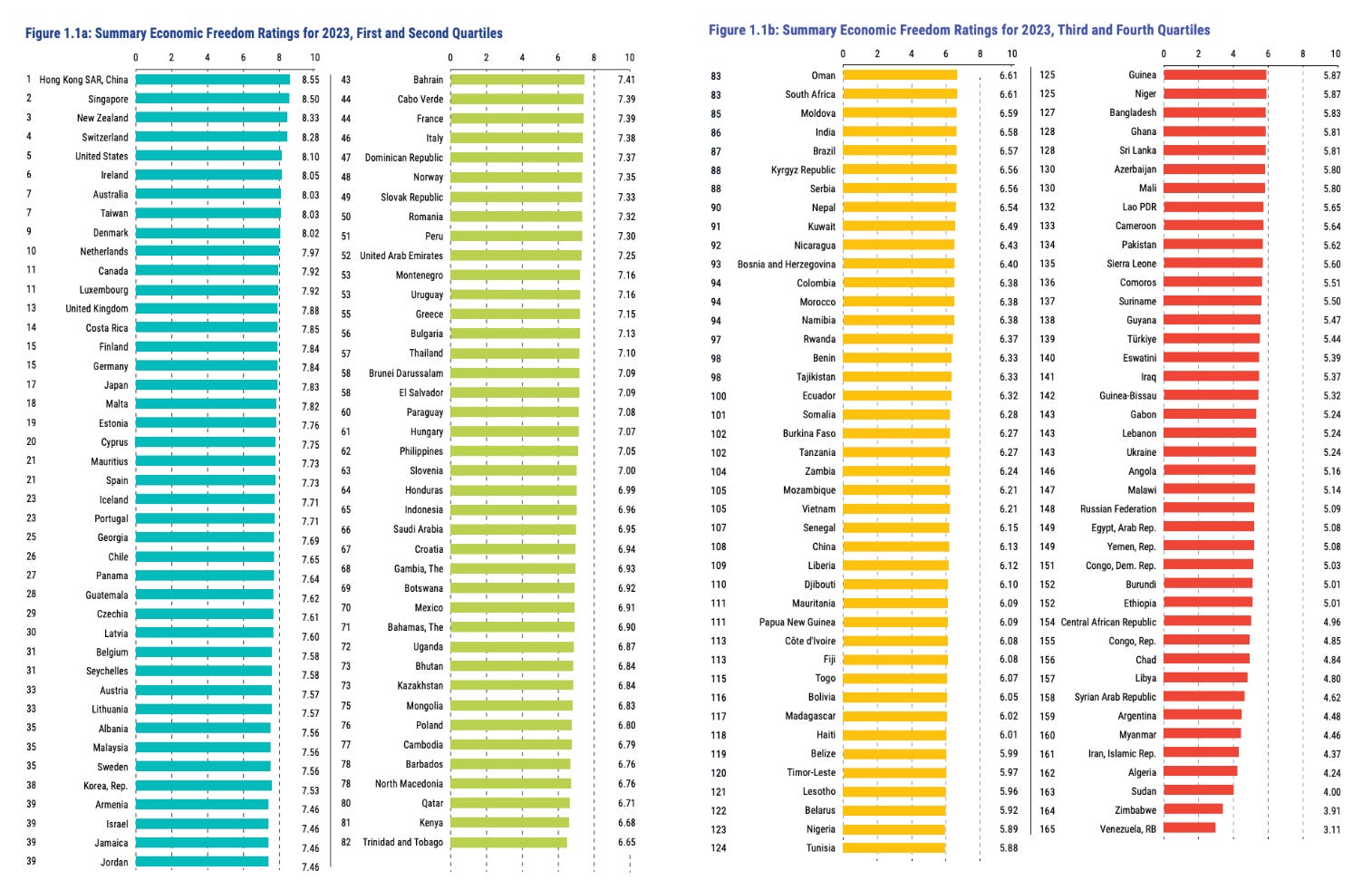
In 2025, the US was ranked 5th globally for Economic Freedom, and the only global superpower to show up in the top quartile (a few great power countries like Germany, Japan, UK were ranked 13th or lower, and then China and India were in the third quartile, Russia in the fourth). Also, not for nothing, but the only countries ranked higher than the US were Hong Kong, Singapore, New Zealand, Switzerland; and I’m not sprinting for the American exit, destined for any of those spots.
Despite all the complexity; all the ink spilled across the black and the red in the ledger of a country’s merit, the goal of a nation should be a simple scorecard. Create opportunity, which creates wealth, which allows everyone to thrive. Protect the mechanisms of that Opportunity Economy, and other problems start to solve themselves. That’s the American Dream.
James Truslow Adams coined the phrase “The American Dream” in his book, Epic of America when he made a very similar point:
“The American Dream is that dream of a land in which life should be better and richer and fuller for everyone, with opportunity for each according to ability or achievement. It is a difficult dream for the European upper classes to interpret adequately, and too many of us ourselves have grown weary and mistrustful of it. It is not a dream of motor cars and high wages merely, but a dream of social order in which each man and each woman shall be able to attain to the fullest stature of which they are innately capable, and be recognized by others for what they are, regardless of the fortuitous circumstances of birth or position.”
Once again, we turn to Benjamin Franklin for insight into this phenomenon, both when he’s describing America as a definition; “not, ‘What is he?’ but, ‘What can he do?’” Or articulating the recipe as how “one man of tolerable abilities may work great changes, if he first forms a good plan and makes its execution his sole study and business.” Tolerable abilities. Not exceptional. The whole premise is that the country is supposed to convert tolerable abilities into great outcomes.
The modern question, though, of the health of that Opportunity Economy is diametrically split.
On the one hand, folks like JD Vance have contrasted his grandparents “almost religious faith in hard work” and the accessibility of the American Dream, against a common modern ailment of “learned helplessness.” So often today, people conclude that the choices they make have no effect on the outcomes of their life.
Then, you have the opposed worldview articulated by Rutger Bregman when he said “there’s almost no country on Earth where the American Dream is less likely to come true than in the U.S. of A. Anybody eager to work their way up from rags to riches is better off trying their luck in Sweden, where people born into poverty can still hold out hope of a brighter future.”
So is the Opportunity Economy anchored in the same old American Dream, its just harder to recognize? Or is it true that we’ve lost the path to prosperity that previously defined what it meant for America to be the land of opportunity?
Here’s my hypothesis. Both camps are describing the same phenomenon from opposite ends. The same access to opportunity does exists; the machine that converts tolerable abilities into great outcomes hasn’t been dismantled. But what’s been lost is the map. The legible, reliable pathways that used to run from effort to reward have been overgrown by cultural warfare, institutional rot, and bureaucratic excess. What’s more, it’s been papered over with well-meaning heuristics that no longer work and often backfire: go to college, just work hard, follow the script.
People try and follow the map. And when it fails to pay out, they assume the system is broken. That’s a rational response. In aggregate, millions of people are running around with outdated instructions that stall mobility. The same logic reframes that inequality. The widening gap between the top and everyone else is less about a broken machine and more about the map surviving mostly for those who already hold it.
Mitt Romney’s biography makes this point; one advantage we have is that “innovation and entrepreneurism are deeply embedded in the American DNA.” But the problem is capital. “Where capital is scarce, hard to find, or not available to entrepreneurs and innovators, good ideas simply die in the mind.”
Many voices in modern American political philosophy anchor to seizure and redistribution; the “democratic socialists” want, simply, to spread the wealth around. But the reality is you cannot subsidize failure and expect wealth. Romney’s biography goes on: “When government heavily taxes investment, innovation, and entrepreneurship, we get less of those things—and fewer new high-paying jobs.”
Our biggest obstacle is that we experienced a post-World War II boom that was so magnificent and empowering that it taught a generation or two of Americans to live life on easy mode (to some extent, especially economically). But, despite that multi-decade data set of wealth and progress with relative ease, the Opportunity Economy is not naturally forming. We might be a nation built on the back of “tolerable abilities,” but someone still has to fund those pursuits, both in time and money.
We used to be quite good at that. We’ve gotten quite bad at that. And it’s caused a whole host of problems for a lot of folks.
Proof Cast In Steel
Over the last few years, as I’ve been writing The Anduril Thesis, I’ve been immersed in the Industrial Golden Age of America during and immediately after World War II.
We went from producing 3K aircraft in 1939 to 96K a year a few years later; we built ships so fast that some were completed in just over four days; we put up the Space Needle in ~8 months, as the front gates of a party. Jon Gertner described Bell Labs as the country’s intellectual utopia, “where the future, which is what we now happen to call the present, was conceived and designed.” Compare the rate of acceleration Bell Labs drove across a host of devices, sometimes 3,000x in short spans; it would be like seeing the modern automobile costing a dollar and going 1K miles on a gallon of gas.
The chip industry, which was born in the US, now produces “more transistors than the combined quantity of all goods produced by all other companies, in all other industries, in all human history. Nothing else comes close.” That’s how Chris Miller puts it. American companies, like Intel, used to stand up proudly and say “venturing is venturing” as they took on Herculean risks. Vinod Khosla borrowed from George Bernard Shaw when he said, “All progress depends upon the unreasonable man.”
Kelly Johnson’s Skunk Works engineers were always a stones throw away from the airplanes they were building. Alan Kay put the whole era’s spirit in a sentence: “the best way to predict the future is to invent it.”
I could go on and on about that Golden Age of Industrial Might. But again, forcing myself to embrace the black and the red ink on the ledger, there is nuance. The same industrial capacity that built a modern empire also sowed the seeds of modern disillusionment. I love the quote from George F. Johnson when he said:
“The trouble with most employers is that they don’t see far enough ahead. If they did, if they had real vision, they’d see that they would be better off paying good wages and helping their workers to lead normal, happy lives, owning their homes and being a real part of the community. But the short-sighted employers want to make quick money, and think they can get it by paying as little as possible, exploiting their workers and the people who buy their product.”
In 1986, Bob Noyce already saw the death spiral America was in as we fell further and further behind in basically every industry. We became what Noah Smith has called the Build-Nothing Country, “where the once-mighty middle class sinks into a genteel poverty and someone else builds the future on the bones of our civilization.”
So we know we can build because we’ve done it in the past. But we don’t today. The biggest obstacle is the loss of the spirit of Redemption. Anchoring any given worldview to a timescale of decades. The belief that we are capable enough and, given enough time, can accomplish anything. That we can redeem ourselves, sins and all. Things can get better if only we think far enough ahead. From capital to culture, the foundation upon which America was built was Optimism.
The Redemptive Spirit
In 1862, Brigham Young led what I believe is the “quintessential American religion” when he built a city in the desert under the refrain: “We are not going to wait for angels, or for Enoch and his company to come and build up Zion, but we are going to build it ourselves.”
In 2008, a Wisconsin town watched its primary employer, a GM plant, quietly die. One woman expressed the same sentiment as the Prophet of my forefathers: “We are not going to wait for the government to come in and rescue us. We are not going to wait for GM to rescue us. We are on our own. Let’s get this job done.”
Two wildly disparate voices across 150 years and dramatically different situations, echoing the same American trueism. “We aren’t going to wait. We’re going to build it.”
It is quintessentially American to try and solve problems. But that has started to dissipate. The hangover of a post-WWII industrial heyday bred a rising generation that were used to good education + good paying job = lifelong security. But that was always a temporary softness, never a structural given.
If we are to rise to the levels of our Redemptive Foundation for the next 250 years, we have some history lessons to re-learn.
But “we’re on our own” never meant every man for himself. The American reflex to being on your own has always been the opposite: to find the others. In Democracy in America, the French diplomat and philosopher, Alexis de Tocqueville, made a keen observation that not only continues to ring true today, but is also under discussed for what it reveals about American Exceptionalism:
“Americans of all ages, all stations in life, and all types of dispositions are forever forming associations…of a thousand different types—religious, moral, serious, futile, very general and very limited, immensely large and very minute….As soon as several Americans have conceived a sentiment or an idea that they want to produce before the world, they seek each other out, and when found, they unite.”
Another author, Matthew Desmond, made the point that ownership, accountability, “association,” comes when there is, as I said before, skin in the game. Again, quoting Tocqueville, “It is difficult to force a man out of himself and to take an interest in the affairs of the whole state. But if it is a question of taking a road past his property, he sees at once that this small public matter has a bearing on his greatest private interests.”
In other words, as Desmond puts it, “it is only after we begin to see a street as our street, a public park as our park, a school as our school, that we can become engaged citizens.” Our desire to associate, be it in the form of startups, communities, churches, social circles — we want to solve problems with likeminded people.
That is a fundamental reason why ease and disillusionment are so deadly. If we see America as neither “our country” nor “our problem,” but a “problematic country” with “unsolvable problems” then we have no incentive or intention to solve it. And that surrender wears both jerseys.
On the left it’s the newly-elected congresswoman who bragged she “wiped [her] hand on the American flag” for lack of a napkin, or Andrew Cuomo’s “We’re not going to make America great again — it was never that great.” On the right, it’s the mirror image. Different politics, same white flag. Marjorie Taylor Greene pronouncing the country “too far gone” and filing for a “national divorce.” Just yesterday, in Mayor Mamdani’s Fourth of July speech, he chose to frame the coming to America:
“Ships full of travelers weary from long journeys, have passed through the narrows, the winds of the Atlantic at their backs. When those passengers lifted their heads to glimpse what lies just beyond the waves, what did they see?… They saw men waiting at the docks to take them into bondage.”
Defaulting to America as an object of shame is a dereliction of duty. A casting off of accountability. Redemption must be sought and claimed, not passively perused. As long as we fail to recognize the critical role that Redemptive Optimism plays in enabling American Exceptionalism, the deeper we’ll fall into a victim mentality of shame culture and disappointment.
A Bet Worth Making
Optimism requires responsibility. My Dad shared the right formula for that with me years ago; “pray as if everything depended on God and then work as if everything depended on you.” Lets shape it to this particular mission. The fuel of the Redemptive Engine of America is hope + labor. Disappointment and shame don’t produce hope. Letting negativity tear us down yields anti-labor; the epitome of counter-productive work.
So let’s shape the bet we need to make around that formula:
(1) Inspire hope in the Redemptive Engine of American Opportunity
(2) Build a framework of Productive Labor in pursuit of valuable outcomes
I go back to this idea of an educated citizenry; people educated enough to pursue important ideas that yield hope. John Quincy Adams’ biographer said it well; America “needed eloquent men as no other, lesser nation did.” Eloquence. Narrative. Rhetoric. What Byrne Hobart writes about as “thymos”; spiritedness, a relentless drive to transcend the limitations of a listless present. We’re drowning in eloquence in service of a poisonous thymos. The bet is that we can awaken a national rhetoric in service of a worthy thymos.
Mitt Romney’s biographer makes this point about that need for worthy rhetoric:
“If our children do not learn about and come to cherish America’s heritage, history, culture, and founding principles, how can they be expected to defend the freedoms on which their country is based? How can young citizens become adult citizens equipped to critically examine contemporary political ideas in the light of history, or become informed about matters of public policy, or even simply understand the value of voting?”
This hearkens back to Cicero’s political philosophy that Charlie Munger talks about: “that it was the duty of the citizenry, particularly its most eminent members, to serve the State and its values wisely and vigorously, even if that required a great sacrifice on the part of the servers.”
On the one hand, you have that responsibility of the citizenry. “Cherish America’s heritage”, “serve the State.” Not an unembodied Bureacratic State. Serve the American people; the institutions, systems, laws, public good. On the other, you have the responsibility of American institutions to try and do what’s best for the people, even regardless of their immediate stated preferences.
There is a rich vein of perspectives where great leaders have tried to do what they felt was best for the American Experiment, regardless even of intermediate popularity. From Adams to Lincoln to Kennedy who have held a deep reverence for the authority of their constituents, but are still willing to “defend their interests against their inclinations... to save them from the vassalage of their own delusions.” Lincoln felt he had the power to sign the Emancipation Proclamation, but also thought he might be wrong. So he determined the people would inform him of which answer was right. He “gave ‘em a year and a half to think about it. And they re-elected” him.
People who cherish America’s heritage and set about to serve the State. Institutions who set about to empower the Opportunity Economy. That’s the bet in motion: hope turned into labor. But, more than anything, the most hopeful thing you can do is have kids. The hardest labor of all. Having children is the most hope-filled demonstration you can offer in favor of the future you want to bring about. Being willing to live, fight, and even die for a world you will never get to see, but knowing that they will. There is nothing more satisfying than planting trees whose shade you’ll never sit in. I’ve planted four. I want to invent the future on their behalf, and I’d make that bet again any day.
Therefore, What?
The country I love is defined by optimistic realism. The willingness to recognize a problem and then fix it. Not the ignorant mass of flag-waving with blinders on, nor the unfettered rage of the mob calling for the dismantling of America. The wide-eyed middle, staring down the full catalog of sins and then setting about, stubbornly and unfashionably, to make the next iteration better than the last.
The active ingredient of hope is action. The most dangerous counter-example is comfort. From H.G. Wells’ Time Machine to Amusing Ourselves To Death to Brave New World; I’ve seen dozens of illustrations of the threat of comfort. The most dangerous thing that ever happened to American action was how well it worked. The post-WWII boom was so total, so magnificent, that a generation or two stopped noticing it was a boom at all. Good education plus a good job equaled lifelong security. We inherited the shade of trees we hadn’t planted, and mistook it for the default climate.
The Opportunity Economy doesn’t form on its own. The redemptive engine doesn’t power itself. The new map doesn’t reveal itself. Each one is maintained, or it is lost. It’s not that comfort is a sin, it’s that its a lie. It whispers that progress is the default and decline the aberration, when the truth runs exactly the other way. The poison pill of ease will lead us carefully down to hell. Human intellect commits suicide when it “sets itself steadfastly toward comfort and ease,” with security and permanency as its watchword, and atrophies into helplessness. And that helplessness is where the shame comes from.
But we are not helpless. We are the solution to the ills of self-government. More self-government. More accountability, association, and labor that the boom let us take for granted. The generation that forgot the trees needed planting can be the one that picks the shovel back up. More optimism. Walt Disney, always dripping with optimism, once said “Somehow I can’t believe there are many heights that can’t be scaled by a man who knows the secret of making dreams come true.” And the dream worth dreaming is Utopian. Because, as Oscar Wilde said:
“A map of the world that does not include Utopia is not worth even glancing at, for it leaves out the one country at which Humanity is always landing. And when Humanity lands there, it looks out, and, seeing a better country, sets sail. Progress is the realization of Utopias.”
Progress is the goal. Redemption is the engine that gets us there. Hope and labor are the fuel. Shame, dissatisfaction, disillusionment, and indifference will never yield any fruit worth bearing. You cannot subsidize failure and expect wealth. You cannot hold up disgust and yield love.
That’s my love letter. I don’t love this country because the red ink has been washed from the ledger, or because I’ve figured out a way to effectively ignore it. I love it because it is ink; it isn’t carved in stone. Not a perfect country, but an infinitely redeemable one. And a redeemable country, kept, is the best thing we’ve ever built.
Thanks for reading! To receive Networked Conviction: My Investing Journal, a collection of portfolio updates, Requests for Startups, and investing ideas for paid subscribers, you can sign up below: