

Consider The Lillies
Who is the Captain of Your Soul?

This is a free weekly newsletter about the art and science of building and investing in tech companies. To receive Investing 101 in your inbox each week, subscribe here:
Summer, for me, becomes a time for reflection. I’m not sure why I’m so pensive, but it happens in the summer and at the end of the year. New Years, sure. Everyone is setting goals and pondering. But the summer consistently finds me reflecting on this idea of ownership. Not cap table ownership, but the kind of ownership in “owning up.” For the last four years, I’ve returned to what looks like the topic of hard work each summer, but in reality, it has more to do with the question of who gets the byline on your life? Who fills out the scorecard in measuring how you’ve lived? And each year I’ve found that the answer is one of personal accountability:
Toil We Must (August 2022): When the world debates whether hard work is a virtue or a vice, my conclusion is it’s neither; hard work is a tool to be used well or poorly.
The Renaissance of Rise and Grind (April 2023): When the world tries to separate people into the hard working and the lazy, my conclusion is the structural disconnect between luck and skill leaves people feeling their work is meaningless and the antidote is rediscovering meaning.
The Hardening of the Great Softening (June 2024): When the world says ambition is dying, my conclusion is that ambition can’t be set for you and, instead, has to come from choosing a quest whose consequences you actually want.
What is an Extraordinary Man? (August 2025): When the world says the extraordinary have a right to trample the ordinary, my conclusion is that to be extraordinary is to seek out the glory of God, and the glory of God is the benefit of other people.
Each time, I choose to enjoy my preferred default to nuance. I’m not trying to say working hard is all that matters any more than I’m trying to say working hard is an exercise in futility. It’s more about the danger of abdicating to someone else the definition of what is worth working hard for (your boss, the market, the loudest people with the most capital). The authority always returns to the individual. No one else gets to set the terms of your ambition. The Grand Individualism of Capitalism.
This year, as I was driving through the desert of northern New Mexico, I found myself returning to that same headspace. And somewhere, in that jumbled ponder lust, I was reminded of a poem. It was a favorite of Nelson Mandela’s and inspired the name of the 2009 rugby movie made by Clint Eastwood. The poem was written in 1875 by William Ernest Henley as he lay in a hospital bed, losing his leg to tuberculosis:
Out of the night that covers me,
Black as the pit from pole to pole,
I thank whatever gods may be
For my unconquerable soul.
In the fell clutch of circumstance
I have not winced nor cried aloud.
Under the bludgeonings of chance
My head is bloody, but unbowed.
Beyond this place of wrath and tears
Looms but the Horror of the shade,
And yet the menace of the years
Finds and shall find me unafraid.
It matters not how strait the gate,
How charged with punishments the scroll,
I am the master of my fate,
I am the captain of my soul.
I wish I was well-read enough in high school to say I’d heard that poem before the Matt Damon movie, but I’d be lying. But ever since reading it, it has always shown up in my mind as an anthem of self-actualization. What felt like manifest destiny in prose. The Master of my Fate. The Captain of My Soul. A raised fist to raw ambition. But as I connect the dots back to my four prior summer essays in preparation for the fifth iteration, I’m reminded that I never actually land on the raw ambition. There’s always a deeper nuance I need to explore.
Prior years have led me to a pragmatic conclusion; don’t let ambition eat you alive. But this year, I find my mind landing less on the topic of accountability, and moving more into the realm of a loss of control. While each of us wrestle with our ambition in pursuit of becoming our “Soul’s Captain,” I find myself thinking more about what, in our lives, are we incapable of captaining? What is outside of our control?
The Captain’s Creed
I’ve written over and over again about the unquenchable thirst to control your own destiny. A friend of mine, who left an established firm to build his own, once put it to me this way:
“There are two kinds of people in the world. There are people who are building trains, and there are people who are riding the trains that other people have built. Right now, you’re riding the train. The question is, when are you going to get off?“
Joining Contrary was my version of getting off the train, at least to some extent. Rather than play a constant game of someone else’s expectations, I wanted to have materially more control over what I did and how I worked. And as I look around at the other would-be Captain’s, I’m reminded that ambition is a non-zero-sum game that benefits us all. I’ve said before that I think we should work harder than we do and be more ambitious than we are. I want for my kids the capacity to seize opportunity and build something they’re proud of.
As a result, the purpose of reflecting on what you can’t control isn’t meant to be a spa retreat, reinforcing the quality of rest and relaxation, taking breaks from the hard work. You can, and should, strive to be the master of everything that is yours to master. Instead, my reflection on hard work this year is that the list of things that are actually yours to master may be a lot shorter than it first appears.
The Things We Can’t Outwork
There are at least two things that everyone would agree are inevitable: death and time. Maybe even one. Time unto death.
In 2024, I wrote about Larry H. Miller. The Disciple of Hard Work who became Utah’s wealthiest billionaire. Well, scratch that. His work made his widow Utah’s wealthiest billionaire. Because after building 90 companies up to $3.2B in revenue, he died.
As he was dictating his memoirs, he said he regretted it. He worked six days a week from dawn to bedtime for 20 years and missed his kids’ childhoods. And he couldn’t get them back. He died at 64, in large part because he was working too hard to manage his diabetes. He should’ve lived longer, not just with the time he lost, but even within the time he did have. Outworked everything but the clock.
There is a concept of memento mori (”remember that you must die”), an ancient Stoic and later Christian meditative practice. One author framed it as “time that is wasted is also wasting us. When we kill time, we are killing ourselves.”
Time is really the only resource that we can’t ever get back. And no matter the size and scale of your ambition, you can’t manipulate it. You can work smarter, you can optimize the calendar, you can accomplish an extraordinary amount relative to everyone else. But at the end of the day, no matter the skill of any Captain, he is never actually commanding the Sea. He is simply navigating it. Appreciating that inevitability is a humbling necessity.
Unavoidable Inevitability
The most acceptable version of accepting unavoidable inevitability is luck. In The Renaissance of Rise and Grind, I laid out my framework for luck: your mental health depends on your accepting that luck is often maniacally random, and unfair, while still betting that “luck favors the prepared mind.” Nassim Taleb, in The Black Swan, goes further and reminds you exactly how much of your existence you did nothing to earn:
“We are quick to forget that just being alive is an extraordinary piece of good luck, a remote event, a chance occurrence of monstrous proportions.“
There’s a great point made by Kevin Kelly where he describes a project called Degree Confluence, which is a sampling of longitude and latitudes at round numbers; effectively the average points across the earth. And what’s so mesmerizing about the project is that each of these points is completely undeveloped.

For as much progress and impact as humans feel they’ve had, the default state of reality is still largely untouched. The universe ran for 13 billion years without me, and will continue to run fine without me. I need to more often appreciate the inevitability of life happening to me in the form of luck.
But even then, with that dinner party-appropriate topic of accepting luck, there still feels like an element of dependency. Going back to the idea of the prepared mind, that’s still MY mind. Even in the face of indeterminable luck, there is still an element of each of us being the protagonist.
Nassim Taleb says that Seneca taught Nietzsche the amor fati, to “love fate,” and even that, the grandest Stoic surrender, is a move you make from the Captain’s Chair. You decide to love fate. Despite the sense of lack of control, luck still feels like a form of “acceptance” that we’re hiding behind because we feel comfortable that we still have our hands on the controls (though ever so humbly). But, in fact, there is a deeper form of uncontrollable dependency that we’re required to accept.
The Hardest Dependency
If the easiest dependency to internalize is luck, the hardest is God.
Luck asks for humility, and humility is flattering; it makes you sound wise. But God actually asks something of you in the form of sacrifice.
Two quotes come to mind.
First, a tweet I’ve never forgotten:
“Believing in God is less about the scientifically untestable idea that some omnipotent creator exists. It’s more about not being arrogant enough to reject there’s something more we can’t fully understand. And there is some wisdom in these ancient stories we ignore at our peril.”
The second comes from Joseph Smith:
“A religion that does not require the sacrifice of all things never has power sufficient to produce the faith necessary unto life and salvation.”
The suspension of arrogance, the acknowledgement of sacrifice or of cost. Whether its claiming ownership of our outcomes through ambition or through “preparing” for luck, we still seek that Captain’s Chair. The Captain of our Soul. But it begs the question; who gave you that chair?
That exact question is answered in a poem written by a Latter-Day Saint apostle, Orson F. Whitney that is, stanza for stanza, a response to Henley’s Invictus:
Art thou in truth? Then what of Him
Who bought thee with His blood?
Who plunged into devouring seas
And snatched thee from the flood,
Who bore for all our fallen race
What none but Him could bear–
That God who died that man might live
And endless glory share.
Of what avail thy vaunted strength
Apart from His vast might?
Pray that His light may pierce the gloom
That thou mayest see aright.
Men are as bubbles on the wave,
As leaves upon the tree,
Thou, captain of thy soul! Forsooth,
Who gave that place to thee?
Free will is thine- free agency,
To wield for right or wrong;
But thou must answer unto Him
To whom all souls belong.
Bend to the dust that “head unbowed,”
Small part of life’s great whole,
And see in Him and Him alone,
The captain of thy soul.
That counterposition is an unruly level of acceptance. I’ve thought so much about ownership, but ultimately the consideration comes down to a willingness to accept what you can’t control. Ultimately, there is a God who has granted you breath to live, work, fight, and achieve. Failing to acknowledge that force leaves you anxious in a way that you don’t need to be.
Consider the Lilies
The title of this piece comes from Matthew 6 that presents an important nuance to that acceptance:
“…Consider the lilies of the field, how they grow; they toil not, neither do they spin: … Take therefore no thought for the morrow: for the morrow shall take thought for the things of itself. Sufficient unto the day is the evil thereof.”
In my mind, “toil not” isn’t an instruction to stop working. One author points out that the lily still has to fight to grow. But what it does not do is “lie awake gnawing at itself over tomorrow.”
“Take no thought” isn’t “take no action.” It’s “take no ANXIOUS thought.” The sin was never in the toiling, it comes in confusing the purpose of toiling with the ability to author the outcome. We’re commanded to work the field, but we’re NOT meant to will the harvest into being any more than the Captain commands the sea more than he navigates it.
There is also a presence of faith in what you CAN control and what you CAN’T. It reminds me of another Biblical story. In the Old Testament, three men are commanded to bow down to a golden idol and, if they refuse, they’ll be thrown into a fiery furnace. Their response doesn’t leave a lot of nuance:
“…our God whom we serve is able to deliver us from the burning fiery furnace, and he will deliver us out of thine hand, O king. But if not, be it known unto thee, O king, that we will not serve thy gods…”
That phrase; “but if not...” has been an important call to action for me. Faith cannot be contingent on the outcome. We can’t consider ourselves lucky just because our outcomes are lucky. Any belief in God can’t have the same incidental outcome requirements. The three men don’t need to know the ending to know what they’ll do. Within their own sphere of control.
The theology I was raised in rejects predestination. We each have a calling appointed before the world was. But it still only comes to pass “on account of faith and good works freely chosen.” Those choices, not outcomes, define who we are. Neal A. Maxwell described that in saying “what we insistently desire, over time, is what we will eventually become.” Rather than being focused on outcomes, we’re focused on the journey of becoming. Who we are is more important than where we arrive.
Don’t Let the Enemy In
That focus on what Brandon Sanderson talks about as “journey before destination” has a counterfeit. There’s a Land of Color song I like called “Don’t Let The Enemy In” that has these lines about how we take care of our bodies and we take care of our things, but we don’t take care of our hearts when we let the enemy in. One versions of letting the enemy in is in the striving for striving’s sake.
One author describes the addiction of ambition this way:
“of all the addictions in the world, the most intoxicating and the hardest to control is ambition. Because unlike drinking, society rewards it… Marius and Napoleon and Alexander… lusted for control over millions, because they lacked control over themselves.“
Morgan Housel, in The Psychology of Money, offers a comparable anecdote about Kurt Vonnegut and Joseph Heller at a billionaire’s party:
“…Vonnegut informs his pal, Joseph Heller, that their host, a hedge fund manager, had made more money in a single day than Heller had earned from his wildly popular novel Catch-22 over its whole history. Heller responds, ‘Yes, but I have something he will never have … enough.’“
Another version of letting the enemy in is often called the “Prosperity Gospel”. “I worked hard, I prayed hard, so God owes me the outcome.” But the reality is this is the exact opposite of “but if not...”. Faith that only survives a satisfactory outcome is the same ambition-defined measure of success that never fulfills.
Both versions have the same rot at the root: not enough.
The hardest FINANCIAL skill, Morgan Housel says, is getting the goalpost to stop moving. But I’d say this is also the hardest SPIRITUAL skill. Denied any framework for “enough”, ambition can rot greatness into dissatisfaction.
The antidote is something I’ve written about before: “Be still, and know that I am God.”
Gordon B. Hinckley tells a story about a problem with no solution, when the words “Be still and know that I am God” came into his mind, and he realized “all I had to do was work at it and do my best, and that the work would move forward.” It was the Lord’s problem. Not his. Just like the lilies can’t stop growing, it’s not an excuse to give up. It’s an instruction to do your part without picking up the outcome, because that part was never yours to begin with.
Prayer & Work
The best summation of that idea, as I’ve written about before, came to me from my Dad: “pray as if everything depended on God, and then work as if everything depended on you.”
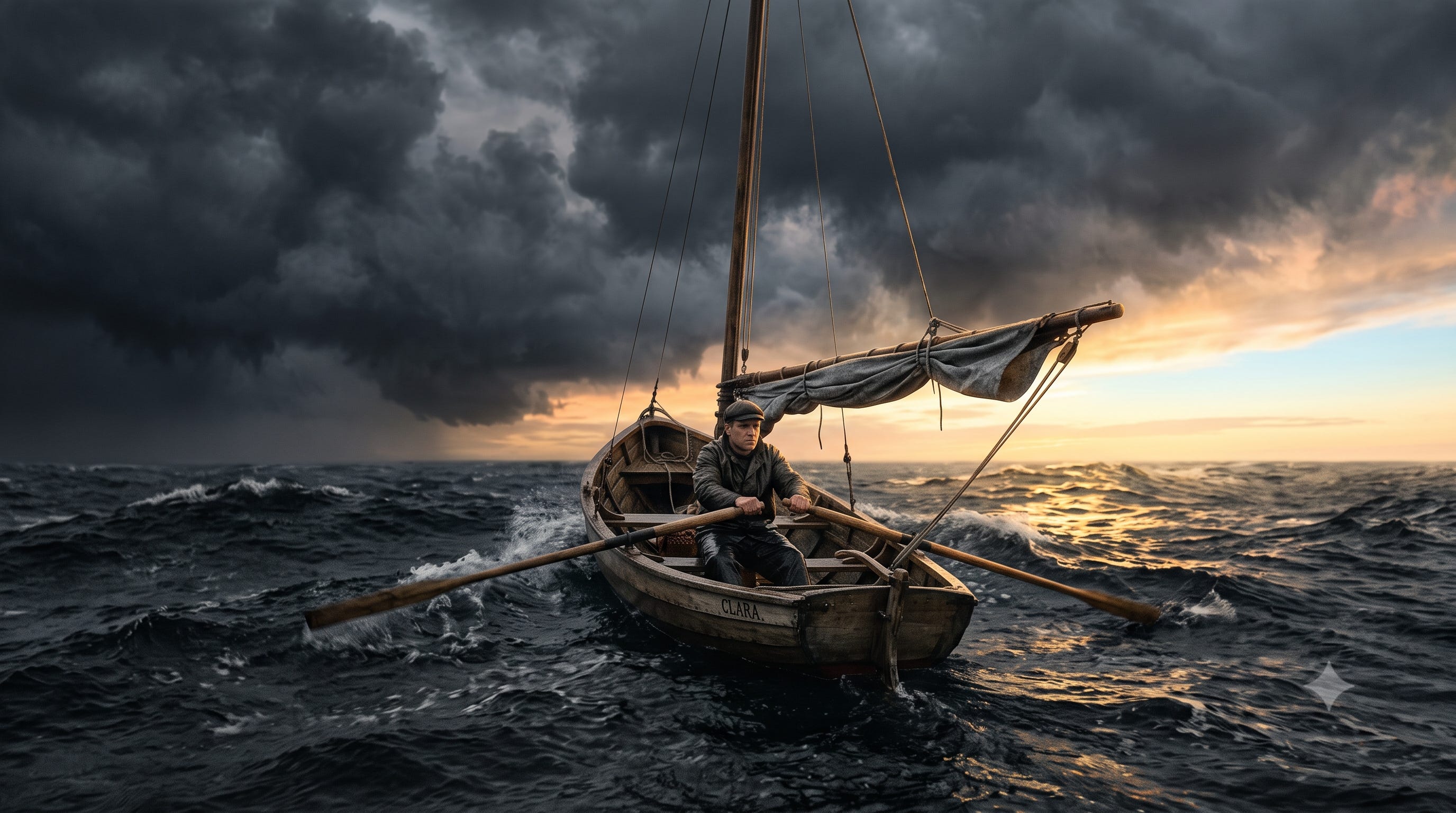
Where Henley puts forward his declarative cry, “I am the Master of my Fate. I am the Captain of My Soul,” you envision this ambitious “head unbowed.” Anything short of that, people feel like they’re not rowing. But sometimes, it has less to do with how hard your rowing and more to do with wondering why you haven’t yet put up your sail?
The end state of ambition was never owning the outcome. Every one of these summer pieces has ended in the same direction: only you can define what’s important to you and what’s worth working for. But the addition to the bench this summer is an actual accounting. Because it isn’t just a question of us doing whatever we think is best. It’s a willingness to account to God what we’ve done with what He’s given us.
As Orson F. Whitney said, “Free will is thine - free agency, To wield for right or wrong; But thou must answer unto Him To whom all souls belong.”
Thanks for reading! To receive Networked Conviction: My Investing Journal, a collection of portfolio updates, Requests for Startups, and investing ideas for paid subscribers, you can sign up below:
This is pure art. Thank you