

Know Thyself
Let Your "Why" Be Your Guide

This is a free weekly newsletter about the art and science of building and investing in tech companies. To receive Investing 101 in your inbox each week, subscribe here:
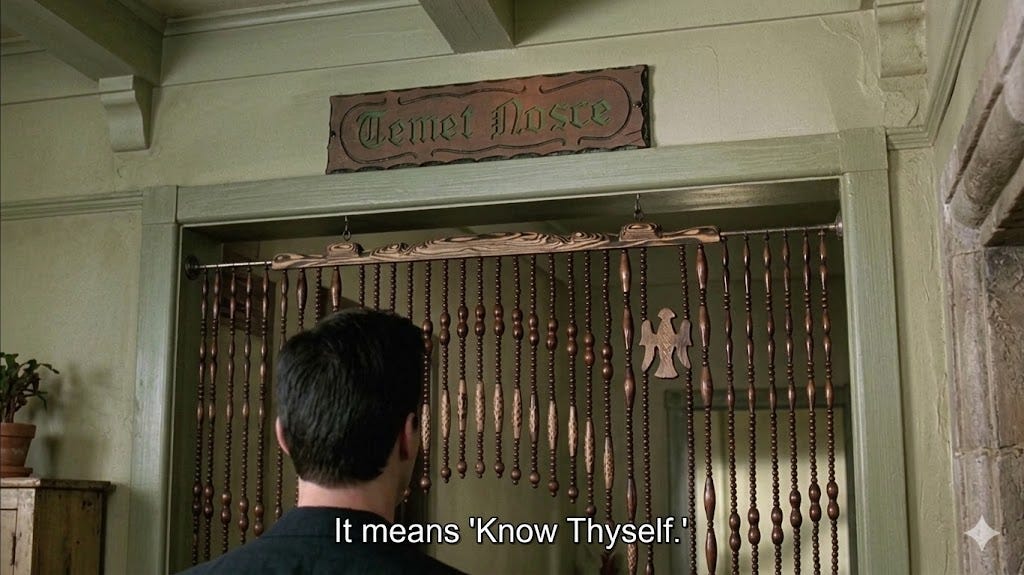
For whatever reason, I’ve been thinking about The Matrix a lot lately. The particular scene that came to mind this week is when Neo is talking to the Oracle about whether he’s The One. She points his attention to a sign that reads “Know Thyself” in Latin. She follows up with “I’m going to let you in on a little secret. Being The One is just like being in love. No one can tell you you’re in love. You just know it. Through and through. Balls to bones.”
That scene came to mind as a a statement about the nature of self-knowledge itself. You can’t be told who you are. You can’t A/B test your way into identity. You can’t read enough Twitter threads or listen to enough podcasts to have someone else hand you the answer. You either know, or you don’t. And most people don’t.
In particular, that came to mind this week because I had a conversation with a friend who is considering new roles and, like so many conversations I’ve had about career paths, it always came back to belief systems and knowing enough about yourself to know what your motivations should be.
Naval’s Compass
I’ve written before about a quote from Naval Ravikant:
“All you should do is what you want to do. If you stop trying to figure out how to do things the way other people want you to do them, you get to listen to the little voice inside your head that wants to do things a certain way. Then, you get to be you... Be yourself, with passionate intensity.”
Naval’s whole framework boils down to a deceptively simple idea: no one in the world is going to beat you at being you. Your specific combination of knowledge, capability, and desire is a product of your unique nurture and nature. It’s unreplicable. Trying to emulate someone else isn’t just less than ideal, but is actually unachievable.
I believe that. And I think its important. But its also incomplete.
Because here’s the practical problem: whether it’s what you build, what you fund, or where you join, the decision should be a function of knowing yourself. But what if you don’t? What if the little voice inside your head is saying twelve things at once and half of them are just anxiety?
This conversation I had with my friend, it felt like all the options were of pretty equal fit, despite being very different. It’s not that the options were bad. The options were fine. The problem was that every option looked equally plausible because there was no internal filter to run them through.
It’s like trying to use a compass that doesn’t know where north is. You can spin it all you want. It’s not going to help.
So where do you get your filter?
Two Theories of Motivation
Just in the last few weeks I’ve seen two frameworks for what internal filter you can anchor to. And they are... not the same.
The first comes from Paul Graham:
“When you’re deciding what to [focus on], don’t try to predict what will be valuable in the future, because that’s so hard that you’ll probably get it wrong. Instead focus on what you personally find most exciting. You can’t get that wrong.”
This is the interest-first model. Follow your curiosity. Chase the thing that makes you lose track of time. The market will figure out how to value that eventually, but you can’t fake genuine obsession. And you shouldn’t try.
Then there’s Palmer Luckey, who is... less gentle about it.
Palmer’s argument, stripped to its core, is this: don’t follow your dreams. Follow your talents. Because most people’s dreams are bad. The number one most desired job for kids today isn’t astronaut; it’s YouTuber. And we’ve built an entire cultural apparatus around telling kids that if they just follow their passion, anything is possible. He thinks that’s a lie. Not a well-intentioned oversimplification. A lie.
His point is anchored to skills: if you’re an average kid who isn’t particularly charismatic, isn’t particularly good at video editing, isn’t particularly good at any of the things required to be a successful YouTuber... why would we tell that kid to follow that dream? In fact, their lives will be miserable trying to chase something they’re not equipped to do. Think how much happier they would be if they focused on their actual skill set and said, “Where can I punch above my weight? Where do I have an unfair advantage?”
I don’t think Palmer is anti-dreams of any kind. He’s anti-bad dreams. He’s fine with astronaut dreams. He’s fine with moon-colony dreams. (He literally wants to be the mayor of a city on the moon; a very Palmer Luckey thing to want.) His issue is with dreams that were implanted by an algorithm rather than forged by genuine capability and curiosity.
Pretty important distinction.
The Stick Has Two Ends
So which is it? Follow your interest or follow your talent?
But that, to me, doesn’t feel like the right question. The right question isn’t passion or skill. It’s do you know yourself well enough to understand where those two things overlap?
Because here’s the thing. Paul Graham isn’t telling you to follow a dream divorced from capability. He’s telling you to follow excitement which, in his framework, is a signal from your subconscious that you’ve found something you’re wired to be good at. Interest isn’t random. It’s diagnostic. The things that genuinely fascinate you tend to be the things where your brain has some structural advantage, some pattern-matching instinct that makes the work feel less like work.
And Palmer Luckey isn’t telling you to grind away at something you hate just because you’re good at it. He’s telling you to be honest about the gap between what you want and what you can do, and then either close that gap or pick a different dream.
They’re both saying the same thing from different directions: know thyself.
PG is saying your interests are data about who you are that you should learn to trust.
Palmer is saying your capabilities are data about who you are that you shouldn’t ignore.
And Naval brings it back together with the whole package, across knowledge, capability, and desire, that is unreplicable. In other words, stop trying to import someone else’s answer.
I’ve written before that “being willing to define success for yourself is being committed to the idea that, once you’ve determined your values, you’re willing to stick to them even if society balks at that decision.” That’s what this is.
The Whiplash Problem

When it comes to questions of defining your drivers, there can be a fine line between letting society balk and actually isolating yourself from anyone not on your journey, which I think is an overreaction.
There’s a scene in Whiplash that I think about whenever someone tells me they’ve “found their calling.” Miles Teller has found his skills-based passion; jazz drumming. The kid who wants to be one of the greats. In this particular scene, his drive has led him to the conclusion that he needs to break up with his girlfriend. And his reasoning is... brutal.
He tells her, essentially: I’m going to keep pursuing what I’m pursuing, and it’s going to consume me. I won’t have time for you. And even when I do, I’ll be thinking about drumming. You’ll start to resent me. I’ll resent you for asking me to stop. We’ll hate each other. So let’s just end it now.
And she pushes back. She says: So I’m just some girl who doesn’t know what she wants, and you have a path, and you’re going to be great, and I’m going to be forgotten?
And he says: “That’s exactly my point.”
And she says: “What the f*** is wrong with you?”
There’s a whole other piece I could write (and many others have) about ambition porn; these movies that languish salaciously in the hard work required for any particular vision. But the key point here is inability to articulate anyone else’s role in your pursuit of self. I hear this a lot from people who don’t want to have kids until they’ve accomplished something great.
But knowing yourself doesn’t mean knowing yourself in isolation. It doesn’t mean constructing a hermetically sealed identity and then demanding that everyone else accommodate it. That’s not self-knowledge. That’s narcissism with a business plan.
Real self-knowledge includes knowing what you need from other people. What you owe other people. That’s a huge part of having kids in the first place; owing it to someone to bring them into the world and make the world a better place for them. Where your ambition ends and your humanity begins. Miles Teller knows what he wants. But he doesn’t know who he is. And there’s a massive difference.
The First Principles of You
I’ve written before that “identifying the first principles of who you are is becoming dangerously well-packaged from all sorts of identity groups.” And I think that’s gotten worse, not better. There are a hundred frameworks now for telling you who you should be. Your Enneagram, your attachment style, your MBTI, your political tribe, your diet, your productivity system. All of them offering a pre-fab identity you can adopt wholesale rather than doing the harder work of building one from scratch.
The more you cede personal responsibility for deciding who you are, the more you empower the people who ultimately are deciding the value system of your in-group. And that’s dangerous. Because those people don’t know you. They can’t. They’re optimizing for the group, not for the individual.
The Oracle doesn’t tell Neo he’s The One. She actually tells him the opposite. But the sign is still there. Temet Nosce. Know Thyself. The answer isn’t going to come from a framework or a personality test or a well-meaning mentor. It’s going to come from the accumulated evidence of your own life; what you keep coming back to, what you’re willing to suffer for, where your interest and your capability and your sense of meaning converge into something that looks, from the outside, like obsession.
I’ve said before that your outputs are a function of your inputs. That’s true for companies and it’s true for people. But here’s the corollary: you can’t optimize your inputs if you don’t know what you’re solving for. And you can’t know what you’re solving for if you haven’t done the work of knowing yourself.
Not what the market wants you to be. Not what your parents expected. Not what looks impressive on a resume. You.
These conversations; career decisions, startup ideas, fund strategies, relationship choices. They get easier across the board when you have a body of work that communicates your interests and perspectives. When you’ve built enough evidence of who you are that the compass finally has a north.
Like being in love. You just know it. Balls to bones.
And if you don’t know it yet? That’s okay. But stop pretending you do. Stop borrowing someone else’s north. And start paying attention to the data your own life is already generating.
The Oracle was right. No one can tell you. You just know it. Through and through.
Thanks for reading! To receive Networked Conviction: My Investing Journal, a collection of portfolio updates, Requests for Startups, and investing ideas for paid subscribers, you can sign up below:
One of my favorite pieces of yours, Kyle. Really resonated with me and am sure for many others as well
I have started to believe recently that some pieces of information or situations in life come to you on purpose. There are some work-related identity struggles that I am currently battling with, but this article was really on point for me.
Thank you for sharing inspiration :)