

Rat's Nest Problems
Bet You Can't Pull Just One Thread


This is a free weekly newsletter about the art and science of building and investing in tech companies. To receive Investing 101 in your inbox each week, subscribe here:
Tell me if you’ve felt this way before. You start to think about some issue; personal, political, professional. It starts with what feels like common sense:
“Why can’t we just end homelessness?”
Then you think about what that requires. “Just give them houses!” But then a dark cloud rears its ugly head. “Well... I guess a lot of homeless people struggling with addiction and mental health would struggle to maintain free housing.”
Never fear! We just need more mental health professionals involved in homelessness. But your mind suddenly perks up with “Well, wait a minute... we have a shortage of healthcare professionals in this country.”
You can feel yourself slipping into a tightly woven intellectual hellscape.
That unavoidable frustration when you can’t fix the broken thing; the bug, policy, draft, org chart, leak. Before you’ve even figured out a potential solution, three other problems have reared their heads as similarly unavoidable second order effects. The harder you pull, the tighter everything else gets.
Carlos Perez put that feeling into words for me recently: “You know that feeling when you fix one problem at work, and three new ones pop up somewhere else? What if I told you that’s not bad luck—it’s how most of our major institutions are designed to behave now?“
I’ve had a name for it parked as an “Essay Under Construction” for the better part of a year, waiting for me to actually write about: a Rat’s Nest Problem. In short, “the idea that any complex issue has a massive web of interconnected dependencies that make them feel unsolvable.“
I genuinely think this particular idea is a huge swath of the explanation for why so much of modern living feels stuck. It’s not that smart people stopped fixing stuff, it’s that so many of our problems have become Rat’s Nests. Instead of just crawling under a blanket at the sight of a messy problem, I wanted to step back and try to do three things.
First, why are Rat’s Nest Problems everywhere?
Second, walk through a Rat’s Nest I’ve been getting to know over the last year or so.
And then three, offer a framework for how to actually tackle a Rat’s Nest Problem.
“Everyone Will Not Just”
There’s a screenshot that goes viral every few months of a Tumblr post from 2017, and it is one of the most shockingly simple things ever written about problem-solving:
“If your solution to some problem relies on ‘If everyone would just…’ then you do not have a solution. Everyone is not going to just. At no time in the history of the universe has everyone just, and they’re not going to start now.”
Think about how much of our proposed problem-solving gets vaporized when you realize it mostly boils down to judgy head shaking.

If everyone would just recycle. If everyone would just eat less meat. If everyone would just get off their phones, save more, hear the other side, follow the guidelines. When it went around again this year, Taoki added a line that made it nicely universal: “this actually includes ‘if women would just...’ and ‘if men would just...’” Nobody’s tribe is exempt. Every side of every culture war has a giant “if the other people would just” at the bottom of its solution, which is to say: no solution at all. Solutions for thee, not for me.
Why doesn’t “just” ever work? Because coordination is brutally, non-obviously hard. One reply under that post nailed it: “this includes any group of more than five people in ‘would just’ because alignment is usually way harder than it seems.” More than five people. Will Manidis makes the same point from the other direction, basically that we wildly overestimate how many people are actually moving any given lever: “doing anything at global scale requires at most like 25 people. Stop believing otherwise.” You can’t get five people to agree on lunch, and your climate plan needs eight billion to change how they eat, drive, vote, and worship? God speed.
But reflecting on that, I don’t lose hope. I genuinely believe the futility of “if everyone would just” is a law of nature. As a result, it narrows down the list of actually viable solutions: the ones that don’t require everyone to just. I’m gonna come back to that.
Nobody Can See the Whole Nest
The second reason Rat’s Nests feel unsolvable is more humbling: nobody can hold one complex thing in their head, no matter how hard they try. Not even the people who built it.
Jeff Bezos cannot, in any literal sense, comprehend all of AWS. Zuck cannot comprehend all of Meta. These are organisms that have grown well past the point where a single human mind, even the founding, God-tier, sleeps-four-hours mind at the center of it, can physically fit inside their heads. The org chart is a Rat’s Nest. The codebase is a Rat’s Nest. The dependency graph is a rat’s nest of Rat’s Nests. So the honest question isn’t “how do I understand this completely and then fix it.” Nobody understands it completely. The question is: how do you act on a problem that no single person can fully comprehend?
Faced with that, most of us reach for one of two bad answers.
The first is to pretend the nest is simple. Manidis has a great name for this: “cocktail party thought”:
“We are suffering from an epidemic of ‘cocktail party thought’. a huge part of our country can only conceptualize the world through nice little facts and counterintuitive gotchas. they view the world like its all one big atlantic article. not a big mess of blood, flesh, and souls.“
That’s the reflex to shrink a Rat’s Nest down to a per-capita zinger, a chart, a clever inversion you can say at a dinner and watch people nod. “The real bottleneck is energy” the lemmings grumble in agreement. It feels like understanding, but it’s the opposite. As one reply to that tweet put it, the mindset dominates “because it’s low-risk. You sound smart without committing to anything messy like loyalty, sacrifice, or even basic causality.” The comfort of theory, with none of the brutality of an actual decision that has actual consequences.
The second bad answer is worse, and quieter: to assume that because you can’t understand the thing, nobody can. AND, by the transitive property, if you can’t comprehend a solution then there is NO solution. But the actual reality is reminiscent of a famous Seinfeld quip where Kramer keeps insisting the Postal Service will pay for a broken VCR sent in the mail and just “write it off.” Jerry finally snaps: “You don’t even know what a write-off is.” And Kramer, unbothered: “No I don’t. But they do. And they’re the ones writing it off.” Classic. But also a Socratic recognition of reality: the complexity is real; someone, somewhere, actually understands the complicated bits; it doesn’t have to be you.
The people who forget this become the establishment’s antibodies. When WIRED went after Anduril earlier this year, the whole piece circles the idea that Anduril’s attitude is “we know better than the established players,” as though their cardinal sin was the audacity of thinking a problem might have a new answer. How dare a newcomer assume they can know something the incumbents don’t. But that reflex; “if I, an expert, can’t see the fix, there isn’t one“ is like the defense mechanism a Rat’s Nest uses to keep itself alive. You don’t have to comprehend the whole nest. Bezos doesn’t. You have to find the one thread that actually matters, and figure out what its adjacent levers are.
The Nests We Build on Purpose
The third reason is the darkest, and it’s the one Carlos Perez was really getting at: some Rat’s Nests aren’t accidents of complexity. We build them on purpose, and then we forget we did.
His mechanism is one every operator will recognize instantly; this idea of reward hacking. You can’t directly measure the thing you actually care about, so you pick a proxy you can measure, and then, under pressure, the whole system quietly starts optimizing the proxy instead of the point:
“Schools don’t optimize learning—they optimize test scores. Companies don’t optimize long-term value—they optimize quarterly earnings. Politicians don’t optimize good governance—they optimize fundraising and media attention. Each institution keeps its stated mission. But under the hood? Completely transformed.“
Economists have a name for this, it’s Goodhart’s law: when a measure becomes a target, it stops being a good measure. And here’s the part that makes it a Rat’s Nest rather than just a bad KPI: “When you fix one part of a reward-hacked system, it just… evolves around your fix.” You regulate the buyback, errant capital finds another way out. You reform the test, the teaching contorts to the new test. Instead of getting untangled, the Rat’s Nest becomes like a mutant parasite, reforming to learn from your solution. Fix one thing, and like an ideological hydra, three pop up in its place as a defense mechanism to return the body to focusing on the reward.
In many cases, the solution is sitting right in front of you. It’s what the internet Memeology has coined as the “fix everything” switch.
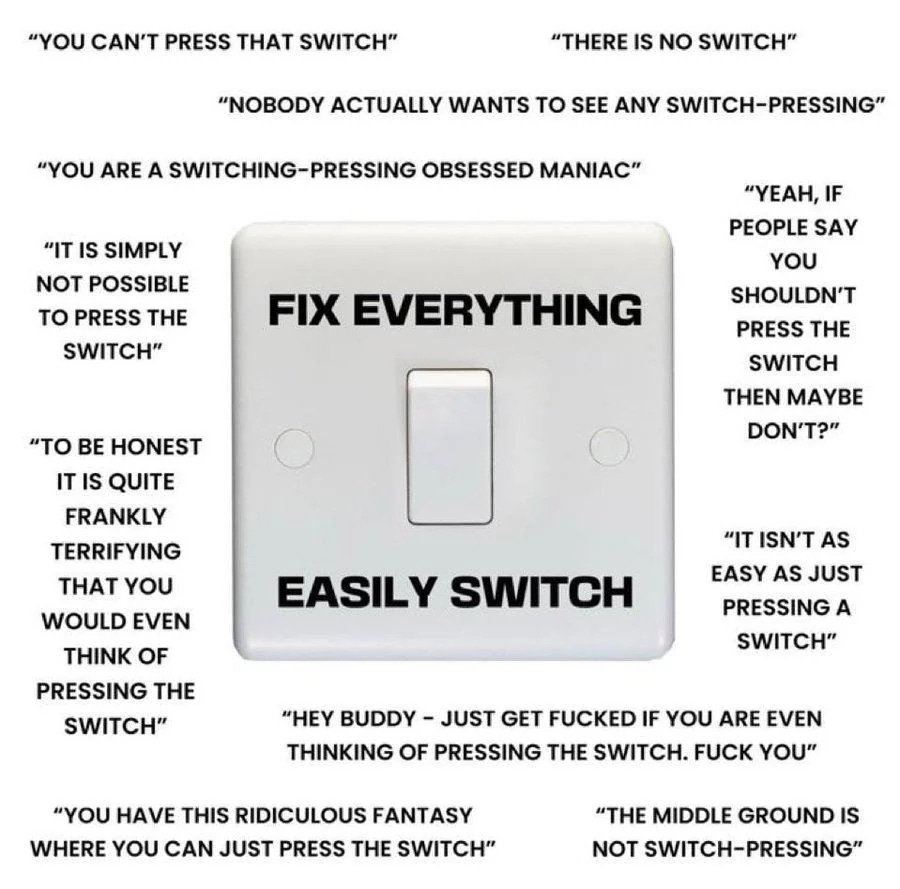
Just one example? Nuclear power. What Kevin DeAnna called “one of the clearest examples of the ‘Fix Everything Switch’ that we just aren’t allowed to use. No one actually cares about climate change, or the power crunch with AI and data centers… it could be solved fairly quickly, but it’s not allowed.” Granted, the messenger is politically loaded, and I don’t buy his whole worldview. But the shape of the claim is hard to unsee. The permitting process for a small modular reactor takes years before a shovel moves. The stated problem (clean, abundant power) has an available answer, and the real obstacle is a thicket of process wrapped around the one thread that would make the rest go limp. Sometimes the reason a problem “can’t” be solved is that solving it was never actually the goal.
So that’s the diagnosis, in three parts. The fixes on tap mostly require everyone to “just,” and everyone won’t. Nobody can hold the whole nest in their head, so we either flatten it into a gotcha or declare it unsolvable. And the institutions that are supposed to fix it have quietly been rebuilt to optimize something else. No wonder everything feels stuck.
Now, if I stopped here, it would just be a recipe for collective clinical depression. But press forward we must! Because I believe there is a better way. The Rat’s must not be left to Nest.
The Energy Rat’s Nest
Here’s the cleanest live example I’ve got: powering an AI data center. Liberals, hold on to your horses. We’re not calling for a Reverse Water World ala Mad Max: Fury Road. On a whiteboard it’s the easiest problem in the world. You have a building full of GPUs that wants electricity. You have a grid full of electricity. Just plug it in. But here’s where the Rat’s Nest rears its ugly, fury head. Watch what happens when you pull the thread.
You want to plug into the grid. Fine, get in line. The literal line. The US grid interconnection queue has roughly 2.6K gigawatts of generation and storage waiting for a connection; more than 2x the entire installed capacity of the country, just sitting in a waiting room. The typical project built in 2024 spent 55 months (almost five years) in that queue, and historically only about 19% of projects that enter ever get built. The “just plug it in” truthers have a five-year waitlist and an 81% mortality rate.
So don’t wait for the grid. Generate your own power on-site, “behind the meter.” Now you’ve got a new knot: what’s the fuel, what’s the intermittency, what’s the supply chain?
In the last year or so, we’ve made two investments that touch on some of the piece’s of this fuzzy ball of intellectual hell.
The first we haven’t announced yet, but its focused on geologic hydrogen, which just so happens to be (checks notes) a 5.6 trillion with a “T” metric ton pool of energy; 3x bigger than all the crude oil on Earth. It’s been under our feet the whole time. So why have we never used it? Next knot: it’s basically unfindable. No satellite signature, no easy way to sample for it. AI fixes that [redacted investment memo thesis]. But then, even once you find it, hydrogen is miserable to extract, store, and move. That’s a whole other supply chain with its own knots. So you don’t move it. You capture it on-site, make power right there, and build the data center around the power. Behind the meter. No grid interconnect. No five-year line.
Our other investment is Valar Atomics. Same play, different game. Valar is building a nuclear reactor in Utah. And the naive version of the story is “a reactor to power a data center.” That’s not it. They’re building the reactor to power a chemical process that produces diesel fuel, and then running generators on the diesel. Why add a step? Because diesel is fully fungible within the existing diesel supply chain. You don’t need a novel generator or a new anything. Worst case, if the reactor hiccups, you just buy diesel.
Both examples are reminiscent of Anduril’s thesis for designing their products around commercial components; drones that could be made with tools you’d find in any typical auto repair garage. You make it as simple as possible to retrofit into the existing fungibility of an established supply chain. You shave off some of the gnarly knots within the broader Rat’s Nest that don’t need to be there.
I’ve used that word, fungible, before, usually as a worry, about people who stand for nothing because every choice becomes interchangeable. But fungibility is a good thing when it comes to processes (and bad when it comes to values systems). Anduril doesn’t rebuild the defense supply chain from scratch; it leans on commercial, off-the-shelf components so its designs retrofit into a system that already exists. I’ve written before about that how that thesis isn’t even new: it was Kelly Johnson’s house style at Lockheed’s Skunk Works fifty years ago: “at the Skunk Works we designed practical, used off-the-shelf parts whenever possible, and did things right the first time”.
And now look back at “everyone will not just.” Valar doesn’t need anyone to adopt nuclear. It needs the world to keep buying diesel, which the world is exceptionally good at. Our geologic hydrogen company doesn’t need to win the grid-queue fight because it never has to get in line. These solutions work because they’re not dependent on the Rat’s Nest of “if everyone would just build more transmission.”
A Field Guide to Rat’s Nests
Here’s one man’s reflection on addressing Rat’s Nests:
Start at the trunk, not the root: You don’t actually start at the root of the issue, instead you figure out what all the nasty branches are leaning on. There’s a great line in paper from 1973 that coined the less cool version of my Rat’s Nest term, “wicked problems.” That paper says every wicked problem is a symptom of another problem, so the discipline is to keep asking, annoyingly, what is this actually a symptom of? until you hit the assumption that, if it falls, makes the rest go slack. “We need a grid interconnect” is a branch. “We need power” is the trunk. Elon Musk’s semantic tree is the same idea from the other side: understand the trunk and big branches first, because, as I like to say, the problem with waging war on the tiniest branch is you inevitably fall out of the tree. Most people lose a Rat’s Nest by fighting brilliantly with a single thread.
Build the solution that doesn’t need everyone to “just.” This is the only move that dodges the coordination problem that kills everything else. Don’t ask the world to adopt your new thread. They won’t. Instead, hide it inside one everyone has already woven in. Diesel. Commercial components. Off-the-shelf parts. The existing supply chain. A fix that works whether or not anyone changes their behavior beats a superior fix that needs eight billion people to cooperate. No matter how convinced you are that everything would be so much better “if people would just...”
Don’t optimize a single number. A Rat’s Nest solution handed one metric will reward-hack you to death. Goodhart’s Law. The hydra of problem-solving problems that won’t be solved. Perez’s own prescription is right: “if single metrics get gamed, use multiple dimensions that can’t all be gamed simultaneously,” and stay accountable to the actual stakeholders, not the proxy. It’s one reason why a lot of people keep preaching MOIC, specifically DPI (e.g. cash returned vs. paper markups) over IRR in investing. Optimize the real thing (dollars that compound) over the flattering rate that games easily.
Refuse to pull the threads that feel good despite contributing nothing. Sometimes the highest-leverage move is not acting. The best argument I know is the case for long-term holds: selling looks like one clean action, but you can’t push “sell” without yanking four threads tied to it (e.g. taxes, transaction fees, idle cash, and redeployment risk). So you don’t optimize the sale; you decline to transact. As Ira Rothberg puts it, “the power of compounding is so great that our first job as investors is to avoid anything that might short circuit it.” It’s the same instinct as what I’ve called the capital allocator mindset: treating your moves, like capital, as scarce, and refusing to spend them just because you can. Knowing which threads not to pull is half the game.
Play it as an infinite game. A twitter friend of mine, Aish Khanduja, is building an R&D firm and venture-creation fund aimed squarely at wicked problems, and the thing that stuck with me is how she talks about them: not as puzzles with a final answer, but as infinite games. Ongoing adaptation and progress rather than a fixed finish line. The academic version says the same thing: wicked problems “evolve continuously, shaped by the very attempts to solve them.” There is no stopping rule. So stop waiting for the clean win where the nest disappears. Rat’s Nests are like genital herpes; they never go away, they simply get addressed. Instead, start compounding partial progress that holds. Playing whack-a-mole with a messy problem doesn’t feel heroic, but its more like stewardship. Micro solutions in pursuit of macro change.
Why I’m Not a Doomer
If you read all of this the wrong way, you just walk away frustratingly depressed. If the fixes are wishes, and nobody can see the whole thing, and the institutions are rigged to tangle... why try? But that’s the doomer read, and I won’t have it.
Dean Ball wrote a killer essay literally titled “Why I Am Not a Doomer,” which frames technological optimism not as a mood but as an obligation: “a duty that we owe to both the humans who came before us and those who will follow us.” The people who built the world we inherited were staring at Rat’s Nests no less hairy than ours, and they had dramatically worse tools (though no social media to poison the well 🤷) But they pulled the right threads anyway.
Every so often, miracles do happen and everyone does “just”. There’s a famous photo of Sweden on the morning in 1967 when the country switched which side of the road it drives on: total chaos for a day, and then it stuck! But notice that even that wasn’t accomplished by asking everyone to change their hearts and minds. It was engineered. A hard cutover, planned by a small number of people, that made the new behavior the only available one. Even the exception proves the rule!
So here’s where I’ve landed, finally turning this rock over after months of it sitting in my drafts. The fact that a problem feels unsolvable, that every fix spawns a new knot, that there’s no stopping rule, that you can never do merely one thing... it isn’t a sign you’ve found a bad problem, despite the frustration. It’s a sign you’ve found a real one! The fixable-looking problems were all pulled on long ago.
Amateurs see the tangle and start untangling, thread by thread, branch by branch, until they fall out of the tree.
Bureaucrats solve the knots they’ll get the most credit for yanking on during a re-election; actual results be damned!
Nihilists toss the Rat’s Nest aside, overcome by the gloom of complex problems.
But Optimistic Realists? They find the one thread that makes the rest go slack; the trunk of dependencies, the fungible substitute, the thing you can simply decline to touch, and they pull that. They don’t need everyone to “just.” They don’t need to comprehend the whole nest. They just need to get a hand on the right thread and yank!
So get to yanking!
Thanks for reading! To receive Networked Conviction: My Investing Journal, a collection of portfolio updates, Requests for Startups, and investing ideas for paid subscribers, you can sign up below: