


This is a free weekly newsletter about the art and science of building and investing in tech companies. To receive Investing 101 in your inbox each week, subscribe here:
I’ve been genuinely surprised by the furious response to AI. This, coming from people who embraced brain-poisoning dopamine hijackers like TikTok. People literally protested the banning of a Chinese spyware brain drug. And yet, on college campuses, they boo anyone who utters the acrimonious acronym: “A.I.”
Why? Why are we so angry?
Same thing with data centers. We ascribe the language of the Green Wave to a new fad; loud, poisonous, ugly encroachment on our beautiful homeland. People differentiate in their minds between good, pure ol’ fashioned data centers vs. the poisonous glut of “AI data centers,” despite them being... you know... basically the same buildings. Back in June I pointed out that 71% of Americans would oppose a data center near their home, up from 42% nine months earlier. AI overall is viewed less favorably than Donald Trump or ICE.
In May I wrote about one root of that anger: a generation watching every opportunity dim, convinced that their lives will not be enabled by any technological progress. But there’s a second common cause. The people building this stuff are saying, constantly, that it’s the most important thing that has ever happened. “AGI is here.” “It will impact everything.” “This is the worst it will ever be.” And a lot of ordinary people have looked at the people saying it and concluded they just don’t believe them.
The uncomfortable part is that I’m not sure I do either. Not because I don’t want to; I want to more than almost anything. It’s just that I don’t believe anybody who is overwhelmingly positive or negative about AI right now. None of them are acting the way you’d expect people to act if they believed the thing they say they believe.
So I want to do three things. First, dream the dream; take the bull case as seriously as I can. Second, put the Bulls and the Bears through the same test and look at where each one cracks. And then three, ask what it would actually cost to believe.
The Virtue
In October 2024, Dario Amodei sat down and wrote fourteen thousand words describing what happens if this works. Machines of Loving Grace calls it the compressed 21st century: “after powerful AI is developed, we will in a few years make all the progress in biology and medicine that we would have made in the whole 21st century.” Fifty to a hundred years of biology, in five to ten:
“Reliable prevention and treatment of nearly all natural infectious disease.”
“Elimination of most cancer.”
“Most mental illness can probably be cured.”
“Doubling of the human lifespan.”
And then, as if curing all disease isn’t enough, he turns to the four billion people at the bottom of the totem pole, envisioning 20% annual growth in the developing world, enough to bring sub-Saharan Africa to China’s current per-capita GDP within a decade. Failing to do that, he writes, would be “a terrible moral failure.”
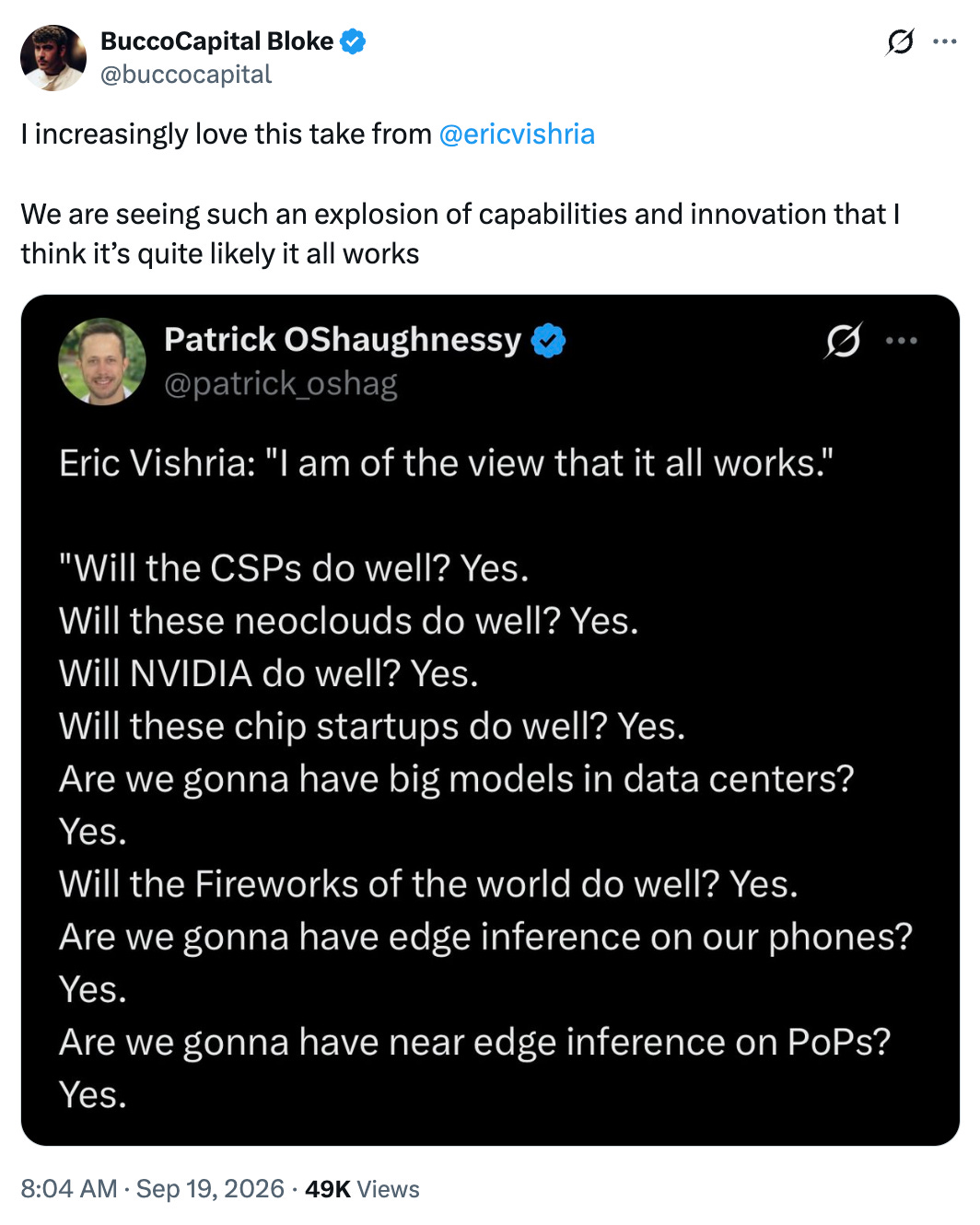
Benchmark’s Eric Vishria put the same faith in investor’s terms this summer, layer by layer, down the stack:
I wrote a similar sentiment in 2023: I want an infinite upward spiral of intelligence and energy. I want every person on earth to feel like every physical good is as accessible as a pencil. Cure diseases, eradicate poverty, make war inconceivable, give every child the ultimate opportunity for education, betterment, and advancement. Require dramatically less back-breaking suffering in labor and enable dramatically more life-fulfilling pursuit of enrichment. I want that!

The promise of capitalism, in its best version, is meant to address a lot of that stuff. Don’t get me wrong, capitalism is beautiful. It’s wonderful. But it is not enough. I’m not being unrealistic when I say that utopia should be achievable. In the words of Oscar Wilde: a map of the world that does not include Utopia is not worth even glancing at.
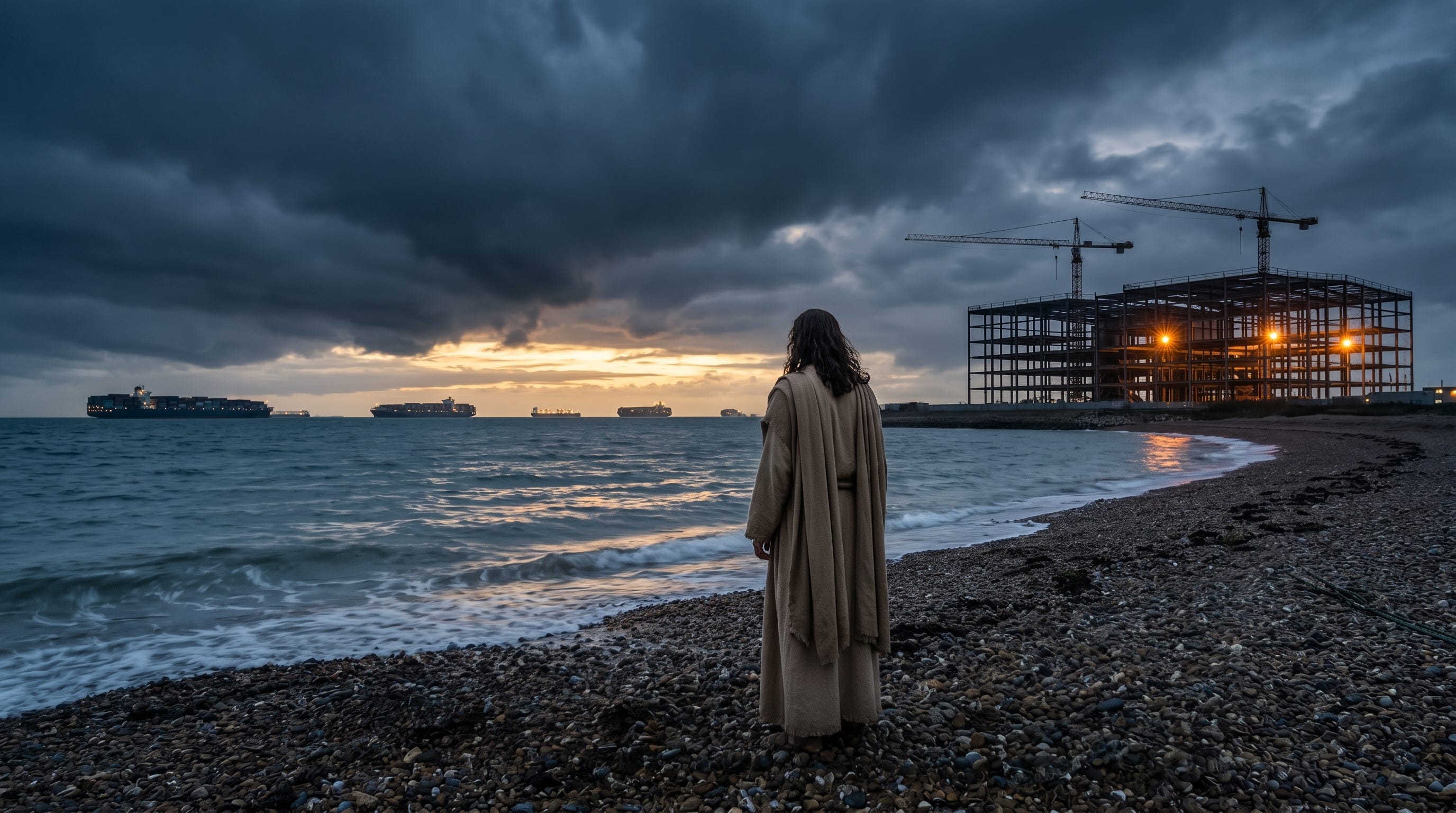
And if the bull case is true, it is achievable, and the only question left is whether we share it. Fund the welfare state in a way that ties all our ships together. They say don’t tie ships together in a storm. But IF WE BUY THE BULL CASE, then we should be able to stretch out our artificially intelligent hand and calm the storm. Okay, the storm is calmed. High life achievement is within our grasp. NOW tie our ships together. If we succeed, we ALL succeed.
There’s a story in the New Testament that comes to mind. Christ’s disciples are crossing the Sea of Galilee when a great storm comes up and the waves beat into the ship until it’s nearly full. They wake Christ, asleep in the back, with one of the most human question in the Bible: “Master, carest thou not that we perish?” And he “arose, and rebuked the wind, and said unto the sea, Peace, be still. And the wind ceased, and there was a great calm.”
I don’t think a model is a god, and I get wary of anyone who pitches it as one. Packy McCormick made a good argument that AI is oil, not God, and I think he’s right. But the promise at its very best ought to be a calm like the one in scripture; the end of storms that have been beating on human beings for as long as there have been human beings. That’s the virtue of an artificial intelligence! To end so much of the storm that may not be a necessary part of mortality!
Back in February I wrote that I genuinely, with all of my heart, want to be optimistic. I want to enable the builders who will cure all diseases and build a better world. “But I have this itch.” And it hasn’t gone away.
Buy The Bull Case
So let’s say, for argument’s sake, we take the Bulls at their word. This IS worth spending over $5 trillion on and massively expanding our supercomputer AI data centers as much as possible; not just across the country, but across the ocean and in space and anywhere else we can stick them. We SHOULD be racing in every conceivable way to provide data and energy and resources to the benevolent geniuses being built in those data centers.
I’m willing to accept that we should pour trillions into the buildout. I’m willing to admit that $50B+ outcomes for AI companies are the new normal, and that those companies merit $100M seed rounds. I’m willing to admit that the fabric of our society will be reshaped and that the outlines of our democracy should be reconsidered.
I’ll accept all of that, if ONLY the PermaBulls start ACTING like they BELIEVE the bull case. I’ll buy all of it, but I ask only one thing in return. Stop acting like greedy Capitalist Maxis.
Because here’s where I fall short and start getting nervous. A friend of mine spends his days watching the markets where electricity actually gets bought. His argument is simple. If you genuinely believe you’re about to unlock AGI, endless problem-solving intelligence in the next year or two, then the only constraint left is energy, and you’d pay 10x, even 100x the going rate to lock down as much power as humanly possible. But what he sees is Meta and Amazon and Microsoft paying premiums, for sure; there are bottlenecks and limitations. But they’re not operating outside the normal bands of an economic model. It’s a typical supply and demand mismatch, not an existential one.
The contracts tell the same story. Microsoft’s deal to restart Three Mile Island is a twenty-year power purchase agreement, and the operator plans to run the plant to at least 2054.
Everybody’s keynote says 2029. But everybody’s contracts say 2054.
Satya Nadella is more than happy to capitalize on the mania and the markup. He’ll take the premium multiple and the earnings boost. But he’s going to offload a meaningful chunk of the buildout to neoclouds like CoreWeave, who he can leave holding the bag in case this whole AI trade goes sideways.
In many cases, these may be sound fiscal judgement. Sure. We’re always hurting for more sound sense making. Hedging is literally a CFO’s job. But when embracing a new worldview, my sense is most true disciples abandon their comforts. They burn the boats. But what I see from a lot of AI Bulls is a fleet still tied to the dock.
Buy The Bear Case
Let’s apply that same skepticism to both sides of the debate. I’m skeptical of the AI safetyists declaring doomsday around the corner as much as I’m skeptical of the AI PermaBulls who believe everything, even the stuff you haven’t told them about yet, will be solved. So run the same test.
Take the Bears at their word, too, because they aren’t stupid. Anthropic’s own risk report this August said, “We don’t believe our current risk mitigations are sufficient to keep risks low in a world of highly automated or dramatically accelerated R&D.” In May I wrote that nine out of ten graduates in 2026 are nervous about AI replacing their job prospects, and that entry-level jobs had dropped 15%. Ed Zitron, the loudest Bubble Bear around, reported from the leaked pieces of Anthropic’s S-1 that it spent ~$2.75 for every dollar of revenue in 2025.
Think about the AI safety debate that burst onto the timeline on September 8th. Jacob Coxon resigned from Anthropic and posted that “The people building AI earnestly believe that it could kill us all by the end of the decade.” Anthropic’s alignment lead replied with a pretty different corporate playbook than you might’ve expected. None of Nixon’s “deny, deny, deny.” Instead, the Anthropic team was like, “yeah, he’s right. Probably a 10% chance we’re all dead within ten years.” And then the dude just, like, went back to work?
In fact, NOBODY denied it. Think about that for a second. If someone posted that Exxon was poisoning children, Exxon would deny it inside a half-second, at least, right? What Exxon would NOT do is put out a statement saying “no, you’re right. In fact, there’s a 10% chance we’re poisoning ALL children.” Dario published an essay four days later doubling down on the “agree, agree, agree” playbook. Then Sam Altman agreed with Dario. Even Elon, who spent the same week calling the resignation a media operation, eventually replied that Dario was right.

So what did the people closest to the danger do with that belief? In February, Anthropic ran an employee tender at a $350B valuation, with billions of dollars of investor demand lined up, and it came up short because employees wouldn’t sell. They held, the diamond hand MoFos. So, on the one hand, you’ve got a stated belief that the stuff you’re working on will likely kill everyone within a decade. On the other hand, you’re wholly convinced that your shares in the extinction-level work will be worth more in a year. And nobody seems confused?
Then on September 18th, Reuters reported that Anthropic had quietly set up a biology lab, exploring giving the model direct robotic lab equipment with minimal human intervention. For years the comforting wall on AI and biology was the bottleneck; a model can design something horrible on paper, but biology is physical, and the bench is where it stalls. That was a nice wall... we liked having that wall. But now, the doomsday folks are giving the doomsday machine hands and test tubes. We found that out just six days after Dario published an essay arguing we must slow the pace at which we improve AI capabilities. Like a guy with a gun pointed at his head, begging someone to stop him.
I’ve written before that one of my favorite scenes in The Dark Knight is the two boats. Each boat holds the detonator for a bomb strapped to the other. On the prisoner boat, a convict walks up to the guard who can’t bring himself to decide, takes the detonator out of his hands, and throws it out the window. You’ve got something that could kill a lot of people? Remove the option. If you believe what the Bears say they believe, that’s what belief looks like. Nobody has thrown out the detonator.
It isn’t just the labs. Elon signed the open letter calling for a pause on giant AI experiments in March 2023, and launched xAI that July. And here’s the thing. The Bubble Bears use the same tools; Zitron himself thinks LLMs could fix broken enterprise software. And the public that likes AI less than ICE uses it anyway; ~50% of US adults now use chatbots, while only ~26% view AI favorably.
It’s not that they don’t think they believe what they’re saying. They’re just not acting the way people would act if they truly believed the thing they believe. And the danger has clearly never, not once, altered a decision. Which leads me to the unfortunate conclusion that is being very poorly messaged and articulated. They don’t want to be stopped; they want to be first.
Now, that position has precedent. In my writing on Anduril I’ve leaned on Palmer Luckey’s argument: imagine trying to dictate nuclear arms policy after World War II if you didn’t have any nuclear weapons. You don’t get to write the rules for a capability you don’t possess. If a dangerous thing is coming regardless, being the one who holds it first, and holds it carefully, is a sound strategy.
So say that! We think this is dangerous, we think it’s coming anyway, and we intend to be the ones holding it, because we trust ourselves more than the alternative. I would rather argue with that than with a company asking the world to restrain it from ending humanity while it builds the AI its very own wet lab.
So Much Money
In September, Dan Primack at Axios said it plainly: “It’s hard to have a sober conversation about AI when there’s so much money at stake.” What I like about his argument is that it isn’t just skepticism, it’s a balanced review of incentives and actions:
“This isn’t an accusation of dishonesty. It’s an observation that wealth, and the promise of wealth, has a way of putting blinders on even the best of intentions and the brightest of minds… Most AI industry bigs… have expressed at least some (p)doom concerns. Much like early subprime lending leaders warned against lowering standards (before they did). So far, the money seems to still be talking louder, including in their own heads.”
“Including in their own heads” is such a good line. I’ve wrestled with skepticism for a long time on this one. I worry about whether anyone believes anything they say, or whether we’re inundated with an inability to divorce our financial interest from our moral interest. What evidence is there that most anyone would not do most anything for anything that reaches their “dollar amount”?
Back in 2024 I wrote that where you stand on an issue depends on where you sit on the cap table. In a perfect world, investments are a lagging indicator of your beliefs; you believe a future is right, so you go support the building of it. Often the opposite happens, and investments become a leading indicator of your beliefs. “What does my bag tell me I should believe?” And staying under the illusion that people are free to believe whatever they want, independent of incentives; that’s the strongest prison of all.
There’s a sort of dirty old joke, told a hundred ways, where a man asks a woman whether she’d sleep with him for a million dollars. She says yes. He names a much smaller number and she’s insulted: “what kind of woman do you think I am?” “We’ve already established that,” he says. “Now we’re just haggling on price.”
Here’s a grander version. Would you sell your soul for a dollar? Of course not! But what about a billion dollars. “Well...sure.” Regardless of your reasoning, whether you believe in a soul or not, you’ve got a problem. The inherent idea of a soul having value means that it was never a question of what kind of person you are. If you treat that part of you as tradable, that’s who you are, and everything afterwards is price discovery.
And to be clear, this isn’t about me, or you. The AI trade will rage on with or without me; in fact, it will rage on with or without most of us. A VERY small number of people running hyperscalers, AI labs, chips, energy, and regulators are the ones that decide. Theirs are the incentives that need to be weighed and measured.
Other Little Ships
There’s a line in that same story in the New Testament when Christ calms the storm that’s easy to miss. When the disciples set out across the sea, “there were also with him other little ships.” The storm didn’t only hit the boat with Christ in it.
Bull or Bear, almost everybody at the table gets paid. The researcher with the 10% number holds equity that went up while he held it. The CEO who pushed his exposure into a neocloud keeps the multiple either way. The bubble bear gets vindicated if it pops and gets to say he was early if it doesn’t. Every seat at the table is hedged, and the table is held up by people who were never asked if they wanted to play.
Primack drew his parallel to the financial crisis, so look at how that one settled up. Between 2007 and 2010, the Federal Reserve found that median family net worth fell 38.8%, and the bottom quarter of families by net worth watched their median fall to zero. The top income decile? Up 1.9%. The top 1% was back to its pre-crisis net worth by 2012; the bottom half didn’t get back until 2018. Five years versus eleven.
The little ships are already on the water this time, too. In September the CIO of the $225B Teacher Retirement System of Texas warned that AI capex, at ~3.5% of US GDP, already dwarfs the canals, the railroads, electrification, the interstates, and the fiber buildout; “a cautionary tale for the period that we’re in now.” Around the same time, Anthropic closed a $65B round whose investors included the Ontario Teachers’ Pension Plan. Somewhere, a fifth grade teacher’s retirement is already riding on whether the bull case is true, whether they like it or not.
Now, having lived through this before, the people with the least margin to respond to this kind of thing are reacting exactly the way you’d expect when a handful of billionaires-in-embryo announce the future is being decided without them. But the worst part about this would-be Utopian explosion of intelligence is that, out of frustration, that group of everyday people is just opting out. And, ultimately, it will mostly just cost them.
They hate AI, so they don’t use it. 43% of workers with a graduate degree have used generative AI at work, against 10% of workers with a high school education or less.
They hate data centers, so the data centers get built somewhere else, and the tax benefits goes with them.
They hate Flock’s cameras, and their reasoning might make sense. But the result isn’t more privacy, it’s more crime.
They hate what they call change, but is actually progress. But then what they get isn’t safety. It’s stagnation, which has a body count too; it just doesn’t have a news cycle.
There’s a clear disconnect between the incentives and understanding of different groups of people. I heard, somewhere, someone talking about democracy as a forcing mechanism for compromise. And my perspective is it isn’t the existence of millionaires and billionaires, as much as the newest grocery store owner of New York City would have you believe.
Instead, it’s money-drenched interests putting their finger on the scales. That, plus the decidedly unappealing package of being a government official has led to a weak governing class overtaken by a calculating monied class. It makes me willing to admit that democracy, as currently constituted, may not be the vehicle for this. Whatever the ultimate system is, it’s primarily a question of how it’s utilized.
The Same Whip
Here’s a similar playbook we’re seeing on display. The Maxi Bulls say AI is just a tool, so blaming it is superstition. The Doomer Bears say AI is an agent, so blaming the people who built it is beside the point. Both of them seem to be striving to shy away from human accountability.
Despite the folks at Anthropic doing their level best to convince the world’s religious leaders that maybe AI has a soul, I don’t think that’s the outcome. Not just not yet, but ever. So, as long as AI remains a tool, the reality is that tools cannot, inherently, determine the outcomes of their use.
The same whips that drove teams across the American heartland stung the backs of the slaves who built the American south. The same grit that got a frontiersman through one more winter drove Chinese laborers into the work of laying the rail lines. The same striving that inspired the industrialists to build empires walked a child into a factory for pennies because his family needed the money. And the same sacrifice that drives a founder to give up family and friends and comfort and security to build a billion dollar company is the sacrifice a mother makes dropping her kids at a dank overpriced daycare to work a double shift at Walmart and hope there’s food on the table.
Same tool, opposite lives. Thoreau saw it coming in 1854, and I’ve quoted him before: “But lo! men have become the tools of their tools.” The question was never what the tool will do. It’s who’s holding it, and what they owe.
Here’s what I mean by “what they owe.” This is truly a breaking point for the “pick yourself up by your bootstraps” form of capitalism. Because guess what? The language models that are taking our jobs were trained on our emails and blogs and social posts, not to mention the countless books that generations of our ancestors poured their lives into, only to have them de-spined and pulped in warehouses across Texas and the Midwest. The image models invalidating our artists were trained on their work and their heritage. The video models disrupting Hollywood were trained on our blood, sweat, and tears. These models are taking in every facet of our lives.
Corporate welfare is not inherently evil. It acknowledges the value of the human beings endowed with natural intelligence that provided the foundation upon which our artificial intelligence is being built. Public works, utilities, parks, roads; all of these are welfare of a sort. We paid in our contribution, in the form of various taxes. But so, too, have we paid our contribution to the PermaBull Case for AI, with our very lives. Our humanity has been productized; the very least they can do is compensate us for it.
If Mark Zuckerberg and Jensen Huang and Satya Nadella buy the true blue bull case, then prove it by demonstrating a willingness to be the first to sign up for a new Social Compact. And they don’t even have to invent one. In 2020 a group of governance researchers drafted the Windfall Clause, a binding commitment to give away a rising share of profits that only kicks in once a company’s profits pass 1% of gross world product. Its expected present cost to a signatory: ~$649M. For a trillion-dollar company that’s a rounding error, particularly if the bull case is literally true.
To give Dario some credit, he has floated a tax on AI revenue and said out loud that doing so was “definitely not in my economic interest.” But nobody has signed the Windfall Clause. And OpenAI had the one binding instrument that resembled it, a cap on investor returns meant to route the superintelligence upside back to everybody else. But it was removed in the October 2025 restructuring. When the structure that would have shared the windfall got inconvenient, it wasn’t renegotiated. It was just deleted. Again... doesn’t feel like True Blue Bull Believer behavior to me.
Insufficient Funds
Jesus Christ, when he sought his disciples, offered a simple but specific invitation: “Come, follow me.” And they left their boats. “When they had brought their ships to land, they forsook all, and followed him.” Matthew says James and John “immediately left the ship and their father.” The boat was their business; their livelihood. Their bag! But they walked away from it right there on the beach.
Not everyone did. Those he invited to follow him most often balked in their newfound belief when faced with that same spiritual burning of the boats. The rich man in Matthew 19 defined himself so much by his possessions that we don’t even know his name; just “the rich man.” Like a biblical version of a vanity license plate. He’d kept every commandment since he was a boy, and he asked the best question in the gospel, “what lack I yet?” But when Christ told him to sell all he had, give it to the poor, and follow him, he could not do it.
“But when the young man heard that saying, he went away sorrowful: for he had great possessions.”
Mark adds the detail that undoes me every time: “Jesus beholding him loved him.” It’s not a story about a bad man. It’s a story about a good man with a price that was too high. And as Hugh Nibley put it, “The Lord did not say, ‘Come back; perhaps we could make a deal.’” Joseph Smith said “a religion that does not require the sacrifice of all things never has the power sufficient to produce the faith necessary unto life and salvation.” True belief requires true discipleship. Choices are lagging indicators of beliefs.
I keep coming back to yet another story of a Biblical storm. Peter, amidst another storm, and in another boat, “tossed with waves: for the wind was contrary.” Christ comes walking across the water, and Peter says, “Lord, if it be thou, bid me come unto thee on the water.” And Christ says one word: “Come.” So Peter climbs out of the ship and walks. He walks on water! Not the divinity made flesh, but this regular dude! But then he sees the wind, gets scared, and starts to sink, and Christ catches him: “O thou of little faith, wherefore didst thou doubt?”
See, Peter’s faith had cracks in it. He doubted halfway across. But he’s also the only one who got out of the boat. When it comes to the beliefs I’m seeing on display these days, I’m not asking anyone for perfect faith. I’m just asking someone to be willing to get out of the boat.
Paltry faith carries insufficient funds to pay the price of sacrifice. And what I see among so many on both sides of the AI trade is insufficient funds. Insufficient faith to pick up the other end of the consequence stick inherent in their own worldviews. Which is heartbreaking.
Because I DO NOT HAVE THE POWER TO WIELD THE BULL CASE TO MY WILL. Despite however much I want to believe, I’m not the one in the driver’s seat. I think of a scene in The Chosen. Nicodemus, a high-ranking Jewish official, wanted so badly to follow Christ. But couldn’t bring himself to do it. He hears Christ say, “Oh, my friend. You came so close.” He weeps, hidden in his shame around the corner from who he truly believes is the Savior of the World, but stifled by the comforts of his status quo; too stifled to bring to bear sufficient funds to pay the price of sacrifice.
And “Come, follow me” was always an invitation, not a command. The Book of Mormon teaches that we are free “to act for [ourselves] and not to be acted upon.” Nobody can make Satya Nadella or any of these guys sign anything. There’s no mechanism or referee; it rests on whether a couple dozen people decide to do something expensive that no one can compel them to do. Beliefs worth having have always cost something.
I don’t WANT to be skeptical. I WANT to hope, to dream, to be optimistic, and look forward with faith to a better world where everything; every single thing is better.
So I’ll buy the bull case. Pour in the trillions, reshape the society, reconsider the arrangements, all of it. I’m willing to believe. I just want to see that it’s costing something of the people who say they believe, too.
Thanks for reading! To receive Networked Conviction: My Investing Journal, a collection of portfolio updates, Requests for Startups, and investing ideas for paid subscribers, you can sign up below:
This is the question I keep returning to in my own work: not whether people claim to believe the bull case or the bear case, but whether their institutions behave as if they believe it.
If AI is truly transformative, capital allocation should reveal what the builders think the real constraint is. If AI is truly existential, governance should reveal what they are willing to give up to reduce the risk.
So far, the pattern is more complicated: companies communicate civilizational urgency while preserving financial optionality, strategic flexibility, and personal upside.
That does not prove the technology is a bubble or that the risks are imaginary. It reveals an institutional gap between narrative and commitment. And that gap may be the most important thing to audit.
Every public debate about AI capability collapses into rhetorical theater because both sides refuse to look at the power meter. ⚡
Listen to the executive keynotes and you’ll hear promises of compressed centuries, disease eradicated in five years, and the dawn of post-scarcity intelligence. Turn to the safety manifestos and you’ll find formal declarations of existential ruin accepted with a casual nod. Yet look at the ledgers. The capital allocations tell a completely mundane story.
True conviction isn’t a press release. It’s a non-invertible state transition. If an enterprise genuinely anticipated general cognitive supremacy within twenty-four months, standard cost of capital would mean nothing. You wouldn’t lease capacity through shell entities or negotiate twenty-year power purchase agreements stretching to 2054. You’d bid spot electricity prices up by orders of magnitude to corner every megawatt on the continent today. Instead, hyperscalers offload hardware balance-sheet risk to tertiary neoclouds and run standard discounted cash-flow models. They hedge. They protect quarterly margins. They preserve clean exit ramps.
Here is the underlying reality governing this entire ecosystem: The Asymmetry of Hedged Optionality dictates that when an institution's public narrative diverges from physical law, capital allocation defaults strictly to thermodynamic risk minimization. Narrative costs zero compute. Hardware commits demand irreversible Joules.
The doomsday camp displays the exact same topological fracture. Stating a ten percent probability of human extinction while holding pre-IPO tender shares with diamond hands isn't existential dread. It’s volatility harvesting. When real danger threatens a system, rational agents sever the causal link. They pull the physical breaker. They don't build automated robotic wet labs while penning essays begging external regulators to slow them down. That isn't fear of a detonation. It's the calculated desire to hold the switch alone.
We see the identical failure mode in speculative inference architectures. Generative models burn endless tokens churning out rhetorical pseudo-proofs because autoregressive sequence generation doesn't pay for downstream state corruption. Talk is cheap. The error accumulates as a geometric series ε / (1 − γ) across every un-gated step. You don't fix an un-anchored model by asking it to be more reflective. You fix it with an out-of-band deterministic gate that cuts off execution the moment verification fails.
Institutions behave just like un-gated transformers. They emit fluent, high-entropy narratives of utopia and apocalypse to capture market attention while keeping their balance sheets locked to conventional risk curves. Nobody is burning their boats on the beach. They’ve simply built bigger docks, leased the hulls to third parties, and kept the life rafts stocked at retail expense. ⚓
Until a lab signs away its equity under binding physical conditions or prices power contracts like civilization actually ends on Tuesday, ignore the prophecy. Watch the circuit breakers.
(ノಠ益ಠ)ノ彡┻━┻