

The Techno-Solutionist Commitment
Casting Off Doe-Eyed Optimism and Dangerous Doomerism Alike


This is a free weekly newsletter about the art and science of building and investing in tech companies. To receive Investing 101 in your inbox each week, subscribe here:
On the Apollo 13 mission, an onboard explosion and mechanical failures meant that the ship’s CO2 filter was malfunctioning and could have killed the astronauts. In the movie, there is a scene where a team at NASA dumps boxes of random items that represent everything the astronauts have onboard, saying “we need to find a way to make this round filter fit in this square hole.”
I would describe this moment as quintessential techno-solutionism. So much conversation revolves around two extremes of a philosophical spectrum: techno-optimists and doomers. But technology is, at its core, about solving problems. In fact, I would argue that just about every aspect of life is about solving problems.
Doctors solve sickness problems. Artists solve soul problems. Accountants solve tax problems. Therapists solve mind problems. Garbage folks solve *checks notes* garbage problems.
I only came across the techno-solutionist moniker this week, thanks to Alec Stapp, but he got it from a 2021 piece by Jason Crawford, who laid out the history of the concept back to at least the 1960s.
He describes the contrast between the defeatist pessimism of the late Paul Ehrlich on one hand, who wrote The Population Bomb, and declared the fight to feed humanity as “over.” We’d lost, he said. And then Norman Borlaug on the other, who developed high-yield varieties of wheat that dramatically pushed forward that same fight to feed humanity. Pessimistic about the problem, but not complacent, and optimistic about finding a solution. Jason describes a solutionist this way:
“Solutionists may seem like optimists because solutionism is fundamentally positive. It advocates vigorously advancing against problems, neither retreating nor surrendering. But it is as far from a Panglossian, “all is for the best” optimism as it is from a fatalistic, doomsday pessimism. It is a third way that avoids both complacency and defeatism, and we should wear the term with pride.”
The reason that the spectrum of optimism and doomerism isn’t quite right is because it invites a lack of critical thinking. Being blindly optimistic is just as ineffective as being blindly pessimistic. They both have second order effects, though I would strongly argue that if you have to be one of them, be blindly optimistic. But if your primary north star is progress, it isn’t enough to be optimistic. You have to be a solutionist.
Venture Capital: a Case Study
My pondering on this topic came from a conversation I had this week that gave me pause. A person who works in tech but isn’t a VC, and has read a fair bit of my writing, posed this idea:
“You can’t really build a business that does any real good in the world -- with that as your primary aim -- if you raise venture capital.”
My immediate response was to reject the premise. And, in fact, her assumption that I would agree with that idea is one of the key fears I have in much of my writing. If you look at my most popular pieces on this blog, 9 of the top 10 most popular pieces are, in one way or another, a criticism of venture capital. Ironically, I refer to my writing as a personal diary of self-loathing because, and I hope this doesn’t come as a shock to any of my readers, I am a venture capitalist.
But my fear is that my criticism of venture comes from a place of understanding that the average reader may not have. And frequently I have found that I may feel like I’m saying “this is broken, lets fix it!” and the response I get is, “yeah, it’s broken! Lets burn it to the ground!”
I was reminded of a quote I’ve referenced before from Walter Isaacson’s biography of Leonardo da Vinci about understanding the rules before you break them:
“The Last Supper is a mix of scientific perspective and theatrical license, of intellect and fantasy, worthy of Leonardo. His study of perspective science had not made him rigid or academic as a painter. Instead, it was complemented by the cleverness and ingenuity he had picked up as a stage impresario. Once he knew the rules, he became a master at fudging and distorting them.”
I believe the same is true in criticizing almost anything. In order for it to be constructive, it has to first be understood. My criticism of venture capital as an industry comes from a place of love. That’s what makes it constructive criticism.
But when this person’s conclusion was “you can’t do good if you raise venture capital” it came from the assumption that venture capital was focused on profit maximization. But this comes from, I think, a lack of understanding of the capital allocation mechanism.
A Defense For Capitalism
First, I am abundantly and unequivocally a capitalist. I believe capitalism and market forces have done more to improve the global quality of life than anything, other than the ministry of Jesus Christ.
There was a series of tweets this week, the first saying “capitalism creates poverty,” and then a retweet doubling down and saying, “capitalism requires poverty.” The replies had dozens of responses demonstrating just how untrue those statements are.
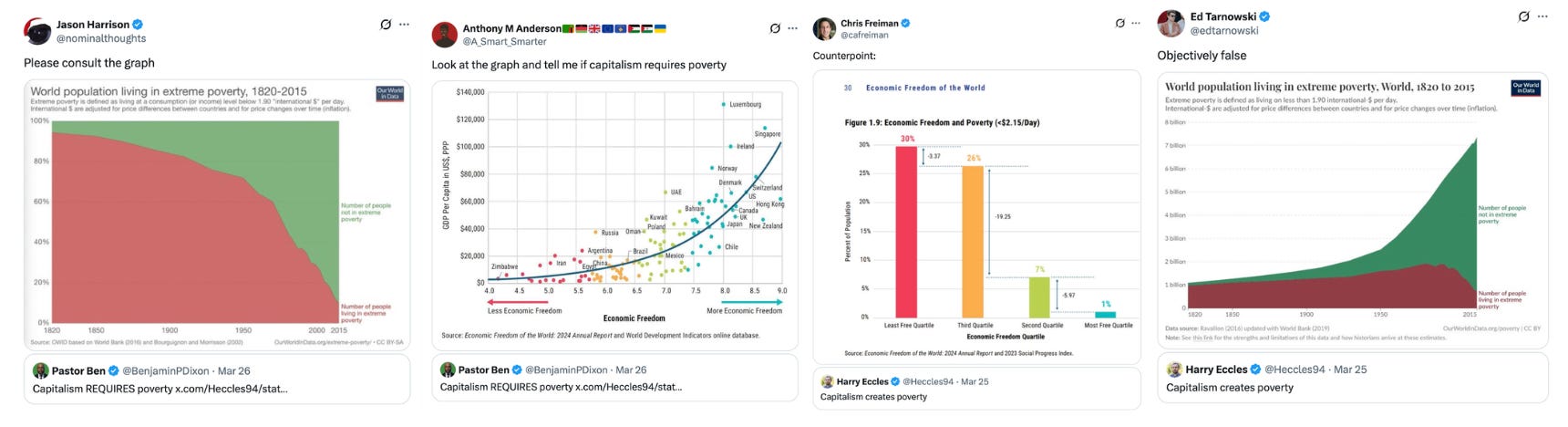
The idea that NOT having a profit motive would improve capital’s ability to make the world a better place has just rarely been true. On scale alone, the three buckets of capital in the US are (1) philanthropy ($390B), (2) government ($3.9T), and (3) capital markets ($65T). The vast majority of capital is being allocated along profit lines. But when you look at the outcomes that capital has driven, the optimal outcomes have almost always come from capital markets.
There’s a famous chart that often makes the round, showing how prices of different commodities have changed over time. Notice anything?

All of the things that got cheaper are exposed to market forces. All the things that got more expensive are either entirely, or excessively, government run or highly regulated. Take just one example. China pulled 680M people out of poverty between 1981 and 2010 after liberalizing its markets, reducing extreme poverty from 84% to 10%.
So when my friend says that you can’t do any good if you’re raising venture capital, that is a false premise. If “doing good” is making the world a better place, venture capital can be an incredibly effective tool to do so. Any critical evaluation of venture capital has to start from the premise that it has been and can be useful. If you can fully internalize that, then you’re caught up to where I am whenever I write this self-deprecating blog.
The Sins of Venture Capital
I won’t rehash everything wrong with venture capital because this blog represents 300K+ words on the subject. But suffice it to say, venture has many, many sins. There are dozens of structural problems, both at the level of financial incentives and within the psychology of the participants in the industry.
In addition, there are countless instances where venture capital has been deployed in pursuit of innovations that make the world a worse place. That is also true. A few weeks ago, I broke down where the $3 trillion of venture capital over the last 20 years has gone:
Big Wins: The mystical power law 20%; maybe ~$600B went into Google, Facebook, Uber, Airbnb, Stripe, etc.
Modest Returns: The 1-3x returns that make up ~15%; ~$450B that didn’t return entire funds for investors, but didn’t lose money.
Productive Failure: The ~25% of failures that make up a bedrock of what I’ve written about before as Silicon Valley’s accelerated failure archive; a “density of documented, autopsied, learned-from failures.” That’s like $750B of the total.
Ineffectual Waste: This is a ~27% cut that starts to get into our playbook; the $800B that went to the 47th food delivery app, the 18th D2C mattress brand. This category exploded during ZIRP and took a lot of capital with it.
Spectacular Failure: This is the 10% of capital that found its way into massive black eyes; $300B for Jawbone, Katerra, Hopin, Quibi, the SPAC-era, most of the SoftBank Vision Fund, or even going back to the Dot-Com blowups like Webvan and Pets.com.
Outright Fraud: Finally, we have the ~3% that went to the criminals; $100B for FTX, Theranos, Nikola, Wirecard, SEC violations and DOJ indictments.
Based on this rough math, there is ~40% of capital that goes to the worst outcomes. You could argue maybe another 10-20% went to “winners” that were net negatives for society (e.g. cannabis, gambling, porn, etc.)
But when high-quality founders receive high-quality capital from high-quality allocators, that is often the most effective way to make the world a better place. More effective and expedited than any philanthropy or government programs.
My goal in writing this blog is the hope that we can increasingly push towards higher quality across the founders and allocators involved in the ecosystem. But in order for me to feel like I have moral license to engage in that kind of constructive criticism, I had to first come to a place of understanding.
The Character of Constructive Criticism
A critical component of Solutionism is constructive criticism. The danger of default optimism is that it doesn’t open itself up to the truth behind criticism. But the danger of default pessimism is that it represents an existential threat to the thing you’re trying to solve.
If you’re saying “I don’t want venture capital to exist” then no one in the venture capital apparatus has any interest in your criticism. The same is true if Democrats or Republicans think the opposing party should be wiped out. Or if atheists think Christianity should be outlawed. Constructive criticism can only come from a place of love; anything else is an existential risk and will be treated as such.
The problem is that people get addicted to criticism. They love fault-finding, especially with large organizations or amorphous industries. It can feel like a unifying force of any in-group; to identify your villains, and rage against the machine in an endless stream of displeasure and disappointment.
Earlier, I mentioned that 9 of the top 10 most popular pieces on this blog are a criticism of venture. Funny enough, the only piece in my top 10 that isn’t really about venture is an extension of why being a Solutionist is the optimal path forward: because complaining is the mind killer. As I wrote a few months ago:
“Complaining is literally voluntary brain damage. We’re choosing to damage our psyche. And, like any addiction, it becomes intoxicating not to stop. The more you complain, the better it feels to keep complaining. It’s your default mechanism.”
It may feel like “I have to criticize for thing to improve.” But solutions rarely come from criticism without empathy.
The Church of Jesus Christ of Latter-Day Saints: a Case Study
Another aspect of my life where I see this is within my faith. The Church of Jesus Christ of Latter-Day Saints has millions of members that have found a rich and fulfilling relationship with Christ through its teachings. And I believe that, quite consistently, people who follow the teachings of the Church are not only exceptional people, but also usually quite happy, and often very successful. But we also have a multitude of detractors.
Leaders of the Church are the first to emphasize that “while the Gospel is perfect, the people are not.” One modern day apostle once said:
“Except in the case of His only perfect Begotten Son, imperfect people are all God has ever had to work with. That must be terribly frustrating to Him, but He deals with it. So should we. And when you see imperfection, remember that the limitation is not in the divinity of the work.”
As a result of that human imperfection, there are certainly ways that the organization and administration of the Church could improve. But so many of the critics of the Church do not come from a place of constructive criticism. They represent Destructive Criticism; they do not think the Church of Jesus Christ of Latter-Day Saints should be allowed to exist. As a result, we are not interested in their criticism.
Meanwhile, there are dozens of people working within the faith to understand aspects of our history, our doctrine, our culture, and to inform and instruct and cajole in a better direction. That kind of constructive criticism is the only path towards any real viable solutions.
Everything Can Be Fine

When I was on my mission, I spent two years feeling deeply inadequate. As far as I was concerned, Jesus Christ had personally called on me to be a minister of his gospel. And I sucked at it. No matter how well I did, I could always see the limitations of my being. I had a sort of catch phrase when I would evaluate myself; “I have to be better.” I have to be better at talking to people on the street, at studying the scriptures, at teaching lessons, at being patient, at being kind. I have to be better.
Towards the end of my mission, I had a powerful spiritual experience. The whole point of Jesus Christ is to enable us to overcome mortality. We aren’t meant to be perfect. We’re meant to be progressing. So, towards the end of my mission, my catchphrase changed from “I need to be better” to “I can be better.”
Inherent in that statement is The Spirit of Solutionism.
The reality hadn’t changed; I still do need to be better. I’m not doing well enough and I can’t be complacent about that.
But the optimistic belief is that I can be better; it is possible. In that particular example, its because Jesus Christ enables me to be better.
But the same is true in every aspect of life. There is literally never a reason to be a defeatist. Even in the face of death, there is no reason to lose hope. As Gandalf said:
“No. The journey doesn’t end here. Death is just another path; one that we all must take. The gray rain curtain of this world rolls back and all turns to silver glass. And then you see it... white shores. And beyond? A far green country into a swift sunrise.”

The Techno-Solutionist Commitment
Everything can be better. But it requires work. Alec Stapp summarized Jason’s Solutionist article this way:
“We can’t just sit idly by and believe things will get better in the future because they have in the past (they might not!). We have to proactively identify problems and engineer targeted solutions to fix them.”
There is a saying that something can’t be hurt by the truth. And if it can? Then it deserves to be.
Two years ago, I wrote a piece called Oh Say, What is Truth? where I issued a clarion call that is as true today as it was then:
“The only thing that can save us now, across almost every aspect of our lives, is a renaissance of truth seekers.
Not argument builders. Not people who are incredibly capable of supporting an argument, building a bull case, or dreaming the dream.
Not influencers; people who can take their unequivocal opinions and super charge it with either dollars or followers.
But people who are genuinely, spiritually, morally, and financially motivated by finding and displaying the truth, whatever the truth may be. People who want to find the truth so that they can act on it. Not people who write the “truth” because of the decisions they’ve already made.”
Solutionism is the commitment to both seek out the truth, no matter how painful it may be, and then to act on it, no matter how difficult it may be.
The Techno-Solutionist Commitment is to seek the underlying truth behind technology’s capabilities; both for good and for evil.
The same social networks that connect us may poison our minds.
The same apps that empower our savings may demolish our livelihood.
The same AI that unlocks us may trap us behind an authoritarian paywall.
We don’t embrace those truths because they mean technology is doomed. We embrace them because they chart the course to technology’s exaltation; a lifting to a higher state of being.
Only in acknowledging our vices can we accentuate our virtues. Knowing what is not working defines the roadmap to what needs to be fixed.
There is a path, but we must walk it. It can’t carry us without our consent or contribution.
Thanks for reading! To receive Networked Conviction: My Investing Journal, a collection of portfolio updates, Requests for Startups, and investing ideas for paid subscribers, you can sign up below:
This reads like a self-inflicted gun shot wound:
> My criticism of venture capital as an industry comes from a place of love. That’s what makes it constructive criticism.
... can we call your bluff? Sometimes folks just have a bone to pick and they call it love when it's just that if you don't pick the food out of your teeth it rots and you get an infection.
And if a higher state of being is staying alive – because any infection could eventually kill you — then you're doing the Lord's work... or just being smart. Criticize away.
has your job ever caused you invest in a person or company that you found to be morally dubious (at the time of investment)?