

Read Old Books
"Never read any book that is not a year old." (Ralph Waldo Emerson)


This is a free weekly newsletter about the art and science of building and investing in tech companies. To receive Investing 101 in your inbox each week, subscribe here:
In 1870, Ralph Waldo Emerson published a collection of essays entitled “Society and Solitude.” One essay, in particular, has stuck with me for years; it is simply called, “Books.”
In it, Emerson lays out his philosophy towards books, both those that do nothing for us and those that “redeem us.” One section, in particular, I haven’t been able to forgot since I first read it, sitting on a bench on a road in Waynesboro, Pennsylvania in 2011:
“Be sure then to read no mean books. Shun the spawn of the press on the gossip of the hour. Do not read what you shall learn, without asking, in the street and the train. If you should transfer the amount of your reading day by day from the newspaper to the standard authors—But who dare speak of such a thing? ... The three practical rules, then, which I have to offer, are:
1. Never read any book that is not a year old.
2. Never read any but famed books.
3. Never read any, but what you like. Or, in Shakespeare’s phrase: “No profit goes where is no pleasure ta’en. In brief, sir, study what you most affect.”
I’ll start with the last at the first. I wrote a few weeks ago about using your excitement as your guide. In the words of Paul Graham, “focus on what you personally find most exciting. You can’t get that wrong.” This is markedly different than “following your passions.” It is, instead, finding where joy, preference, satisfaction, fondness come from and letting that be your guide. You will find it difficult to do anything consistently if you don’t enjoy it. And if you can’t do it consistently, then you’ll likely never do it well.
The second, I find to cause a cognitive dissonance for me. On the one hand, there is a Lindy effect in literature. The longer something has stayed in rotation, the more likely it is to be better. I think this is largely true, and was certainly even more true in Emerson’s day; information worth having was worth re-printing.
That being said, I think the “always on” framework the internet has applied to information can short circuit the law of natural selection for ideas. Ideas can become pervasive, not because they’re good, but because they’re known. The prevalence of Twilight or Fifty Shades of Grey may speak to this phenomenon.
But, as with all proverbial arcs, this one bends towards truth. The test of time will often root out what was incidental excitement in favor of longevity-prone truth.
Finally, we come to the first principle. This is the one that most stuck with me over the years. “Never read any book that is not a year old.” Pmarca recently declared his barbell approach to content: tweets by the minute on one end, 50-year old books on the other. But why does Emerson shortchange the cutoff at just one year? Why not 100 years? The books he goes on to list in his essay have authors like Homer, Shakespeare, Herodotus; hardly just a couple years old, even when Emerson wrote it in 1870.
The principle, I think, in modern parlance, is distance from “the current thing.” How often have there been books that feel rushed to production? Dozens and dozens on the most recent thing Donald Trump has done that everyone hates. Or the O.J. trial, Princess Diana’s death, 9/11, COVID, each spawned countless renditions of breathless commentary. But none have stood the test of time.
But what you need is what Emerson was prescribing. Distance from the current thing. Another piece of commentary in the Emerson excerpt above, that I love, is when he says, “do not read what you shall learn, without asking, in the street and the train.” Without asking. Because the current thing, as we know, will assault your sense whether you like it or not.
So, where do I find myself in the pursuit of the old? As I wrote about in my first post of the year, a great post from Gregory Blotnick inspired me to read Will and Ariel Durant’s Story of Civilization. I’m about 500 pages into the first book; maybe 55% done? At this rate, it’ll take me ~8 years to finish all 15K pages. It took Blotnick 5 years, so I need to pick up the pace!
But, already, I can see the “test of time” being unable to touch that series. I don’t mean that everything is up to date; the first book was written in 1935. Plenty of new archeology and scholarly work has been done to shift what was known when the Durants were writing it. Instead, I mean the level of quality and ambition that went into its production. You can feel it on the pages. From the Preface, alone, I was gobsmacked.
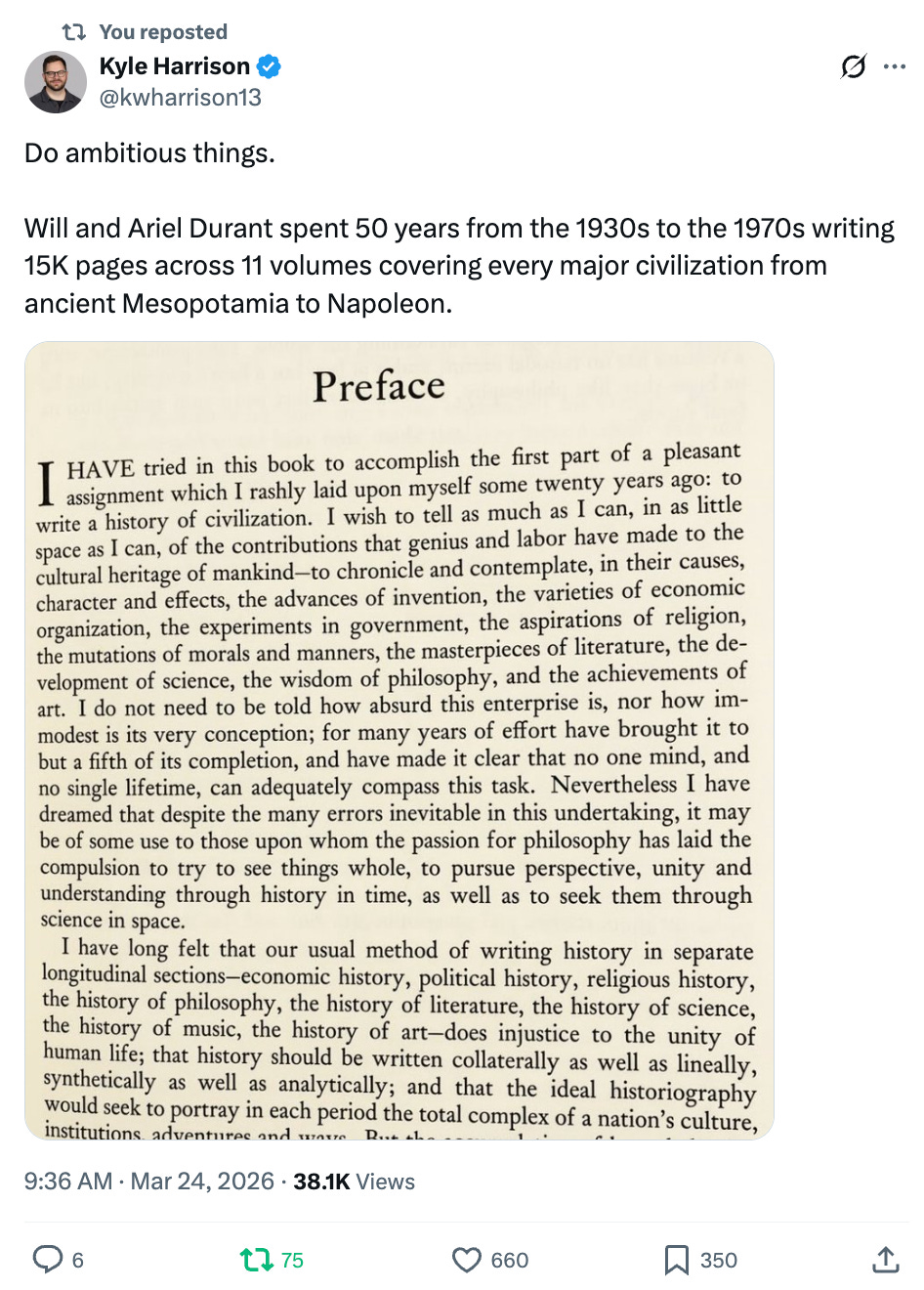
Let me set the stage. Will Durant was born in 1885. In 1915, he was 30 years old and he said to himself, “I want to write a history of civilization.” His friends may have asked him, “which civilization?” And he said, “all of it.” Then, he proceeded to do it over the course of the next 40 years; publishing the eleventh volume in 1975. He died six years later at the age of 91. He poured his life force into these books.
I’m no historian. And my editor at Contrary Research is much more of a Classics guy than I am, so I’m sure he would have a more articulate perspective. But my cursory justification for why Story of Civilization holds up so well, despite not being “cutting edge archeology” is because what Durant isn’t seeking either end of the informational extremes. It isn’t a perfect, exhaustive, detailing of facts. But it also isn’t a salacious click-baity call for attention.
History was the backdrop against which Durant sought truth. He wasn’t mired in the academic minutia of covering every detail. In fact, he frequently says “I cannot cover everything we know.” But that’s why he called it the “Story of Civilization,” rather than something like The Civilizational Encyclopedia.
Take just one example from a chapter I recently finished on Akbar The Great in India. His children actively sought his death in hunger for his throne, despite him being what Durant called “the justest and wisest ruler that Asia has ever known.” In the first section after his death, the Durant’s include this observation on the children of great men:
“The children who had waited so patiently for his death found it difficult to hold together the empire that had been created by his genius. Why is it that great men so often have mediocrities for their offspring? Is it because the gamble of the genes that produced them -- the commingling of ancestral traits and biological possibilities -- was but a chance, and could not be expected to recur? Or is it because the genius exhausts in thought and toil the force that might have gone to parentage, and leaves only his diluted blood to his heirs? Or is it that children decay under ease, and early good fortune deprives them of the stimulus to ambition and growth?”
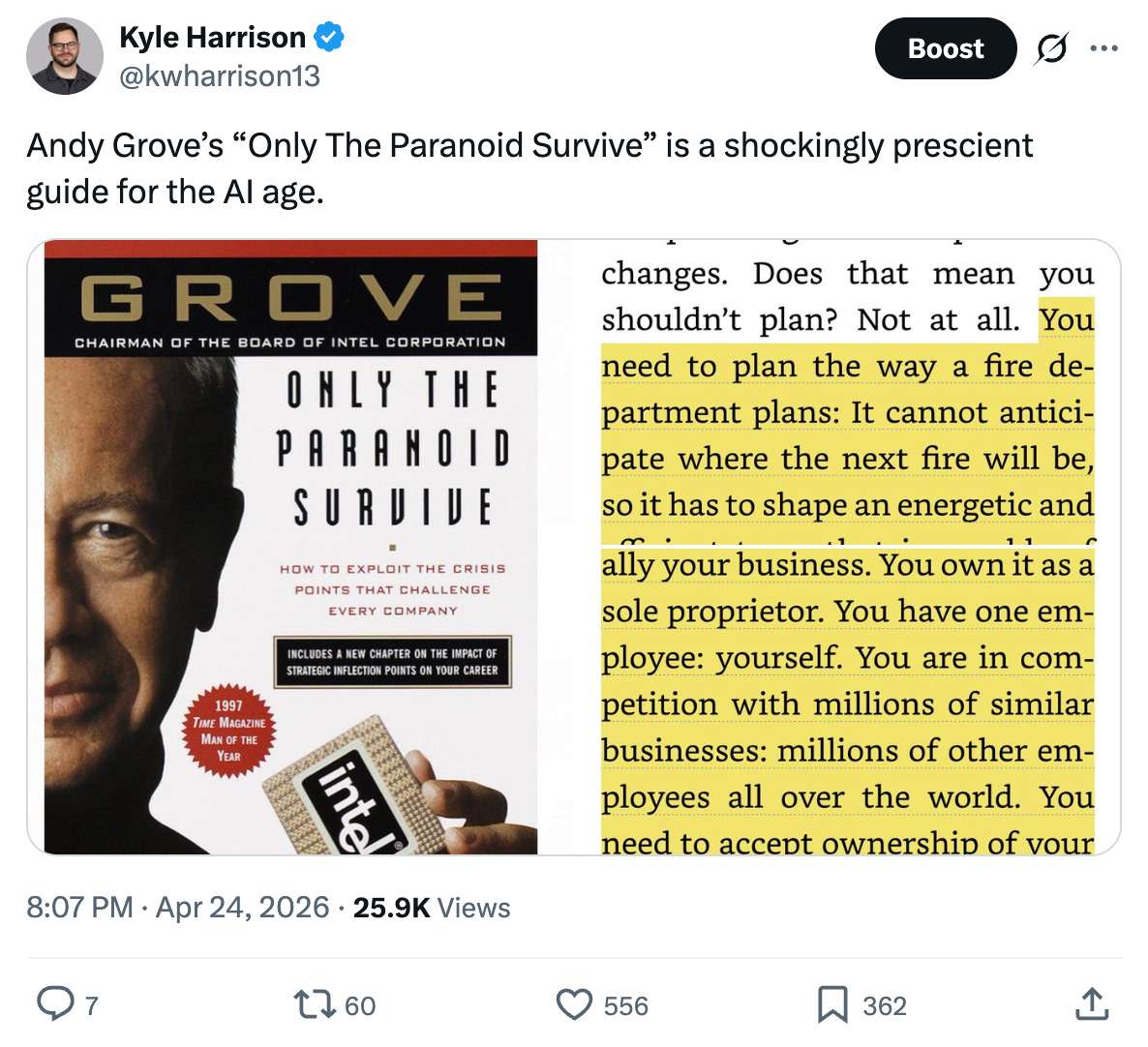
Whether the book is 1,000 or 100 or 10 years old, I’m seeing a comparable pattern. Another book I’m reading right now is Only The Paranoid Survive, written in 1999 by former Intel CEO, Andy Grove. He wrote it as an exploration of “crisis points” when businesses experience “10x changes.” But what I noticed was that the principles are true, regardless of the time and circumstances. The relevance feels particularly poignant amidst, for example, an AI Revolution.
In conclusion, read old books.
There are great companion pieces about why to read and how to read. But once you’ve warmed up the engine and put it in drive, the question is where to go.
My suggestion?
Read old books.
Thanks for reading! To receive Networked Conviction: My Investing Journal, a collection of portfolio updates, Requests for Startups, and investing ideas for paid subscribers, you can sign up below:
damn so i shouldn't have read this??
haha jk, nice work